




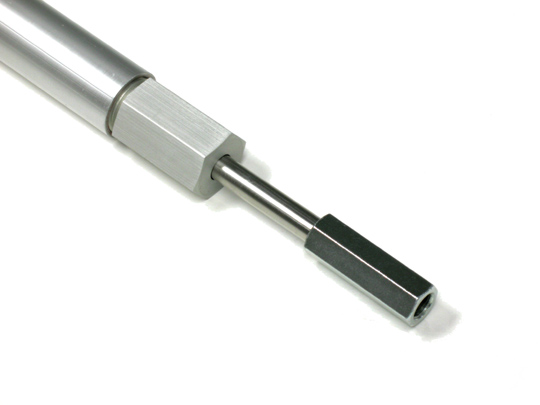
For Core Rod Mounting.
Need help deciding which product is right for your application? Have questions about a particular product? Speak to an experienced application engineer at H. G. Schaevitz Alliance Sensors Group by calling us at 856-727-0250 or contact us by clicking here.
| : |
 Download Rigid Nut Kit Information
The rigid nut coupling is the simplest and most direct method for connecting an LVDT or LVIT core rod to a measured object — a threaded nut that engages both the sensor's core rod thread and the mating thread on the actuator stem, valve rod, or machine element being measured. The rigid connection ensures that every displacement of the measured object is transmitted exactly to the sensor core, with no compliance or backlash that would affect measurement accuracy.
When to Use Rigid vs. Ball Joint Coupling
Rigid nut coupling is appropriate when the sensor axis and the motion axis are parallel to within a few degrees and the installation does not introduce angular misalignment that would cause the core rod to deflect and contact the sensor bore wall. If significant misalignment is present or expected — from thermal expansion, structural deflection, or manufacturing tolerances in the mounting hardware — a ball joint coupling should be used instead. Side loading from core rod deflection introduces friction into the core travel, creating hysteresis errors that rigid coupling would avoid if alignment is maintained.
Thread Specifications and Material
The rigid nut coupling is available in both imperial (5/16-24 UNF, 3/8-24 UNF) and metric (M8 x 1.25) thread specifications to match the core rod threads used on different ASG sensor series. Stainless steel construction is standard, providing corrosion resistance compatible with the stainless steel sensor housings and suitable for the wash-down and high-humidity environments where these sensors are commonly deployed. Thread engagement depth should be sized to prevent the core rod from bottoming in the nut before the sensor reaches its full-retract stop.