






%202.jpg) What’s an LVIT and how are they used? LVITs, Linear Variable Inductance Transducers, have been around for more than 40 years. They are contactless linear position sensing devices that utilize eddy currents produced by an inductor magnetically coupled to a conductive movable element to vary the resonant frequency of an L-C tank circuit. A common form of an LVIT uses a small diameter inductive coil wound on an insulated rod inside a conductive target tube mechanically coupled to the moving object. Another version uses an inductive coil wound on an insulated tube with a conductive solid rod for a target. In either case, no physical contact is required between the coil and the movable target.
What’s an LVIT and how are they used? LVITs, Linear Variable Inductance Transducers, have been around for more than 40 years. They are contactless linear position sensing devices that utilize eddy currents produced by an inductor magnetically coupled to a conductive movable element to vary the resonant frequency of an L-C tank circuit. A common form of an LVIT uses a small diameter inductive coil wound on an insulated rod inside a conductive target tube mechanically coupled to the moving object. Another version uses an inductive coil wound on an insulated tube with a conductive solid rod for a target. In either case, no physical contact is required between the coil and the movable target. 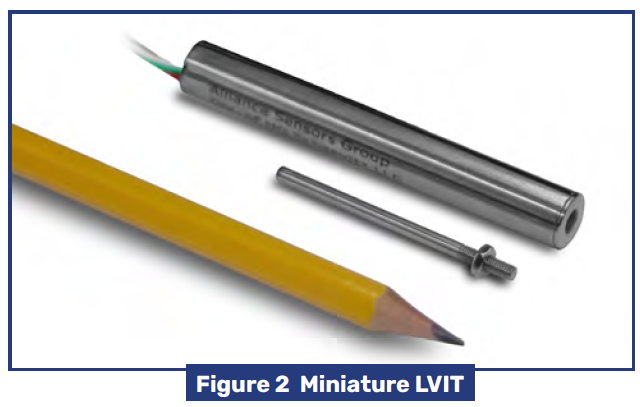 LVITs are available in unique, compact-designed miniature versions having housing diameters of 0.375-inch (9.5 mm) and 0.50-inch (13 mm), standard models with diameters of 0.75-inch (19 mm) and 1.00- or 1.06-inches (25 or 27 mm), and heavy duty housing sizes of 1. 31-inch (33.4 mm) and 1.75-inch (44.5 mm) diameter. This range of housing sizes for LVITs can be seen in Figure 1, Figure 2 shows the miniature sensor, and Figure 3 shows a cutaway of a typical LVIT. Most LVITs are environmentally rated IP-67. All LVITs meet the EU’s CE requirements for EMI susceptibility and radiation testing, and meet the EU’s RoHS standard. Many LVITs are available with rod-eye ends to simplify in-line mechanical installation.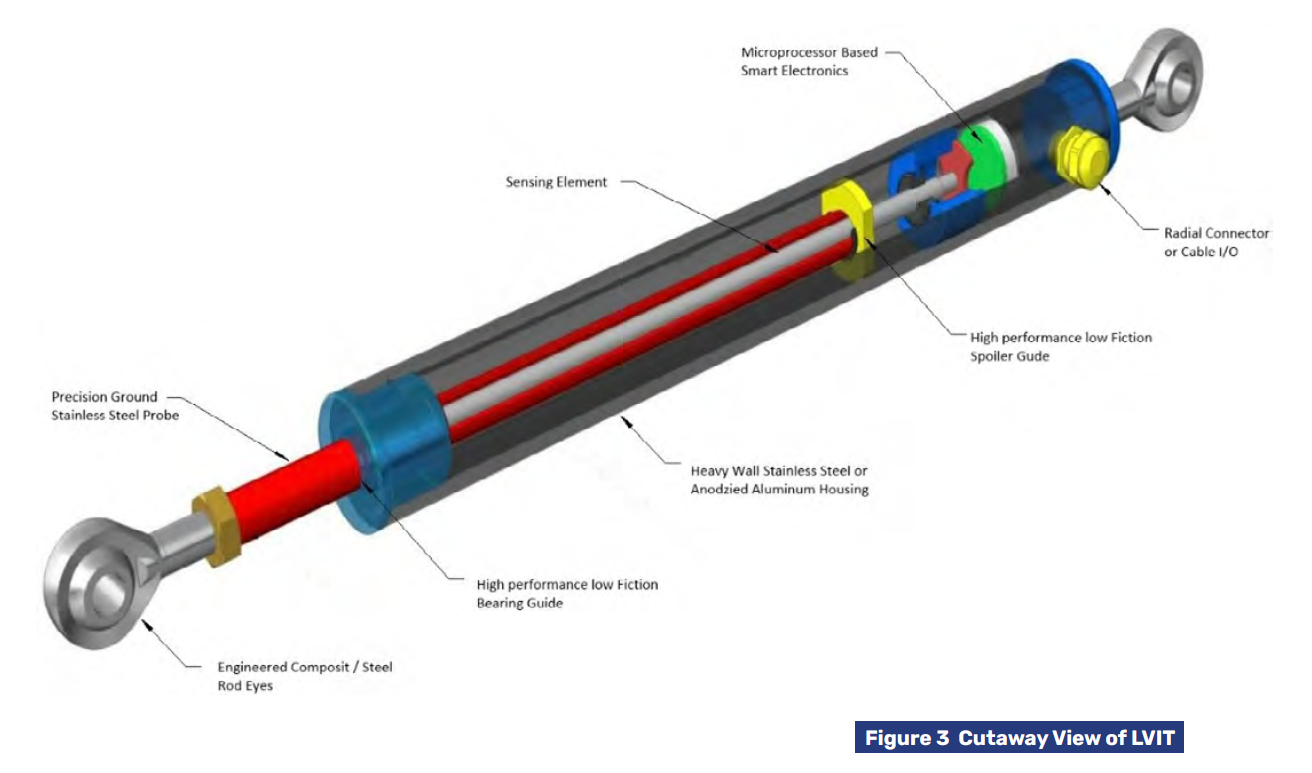
TAILORED LVIT TECHNOLOGY FOR DEMANDING APPLICATIONS
LVITs are found in a wide variety of applications that require position information or feedback. Typical applications include mobile hydraulics, subsea equipment for off-shore platforms, civil engineering for bridge and structural testing, electric power generation, energy development, and factory automation. Let’s take a closer look at how LVIT technology excels across various demanding applications.
PROVIDING RELIABLE, ACCURATE POSITION FEEDBACK SOLUTIONS FOR MOBILE AND SUBSEA HYDRAULIC SYSTEMS
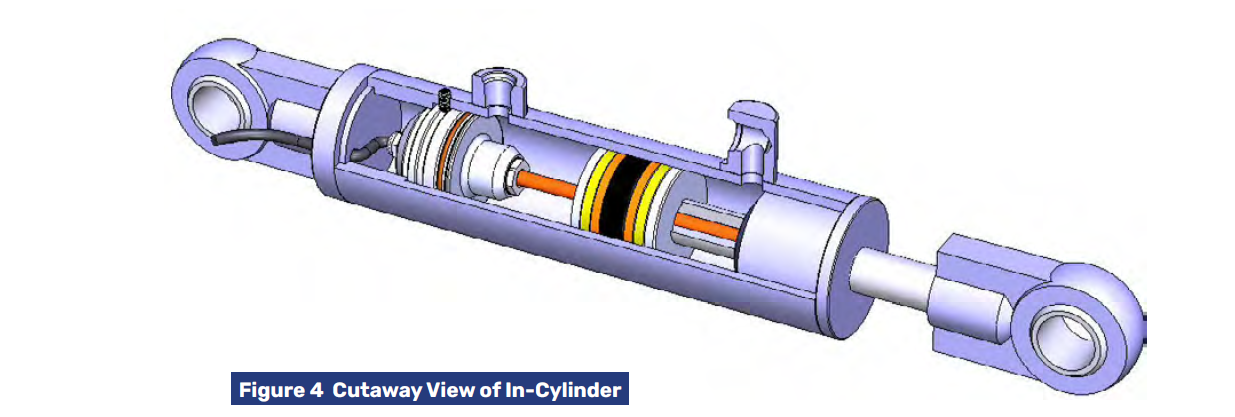
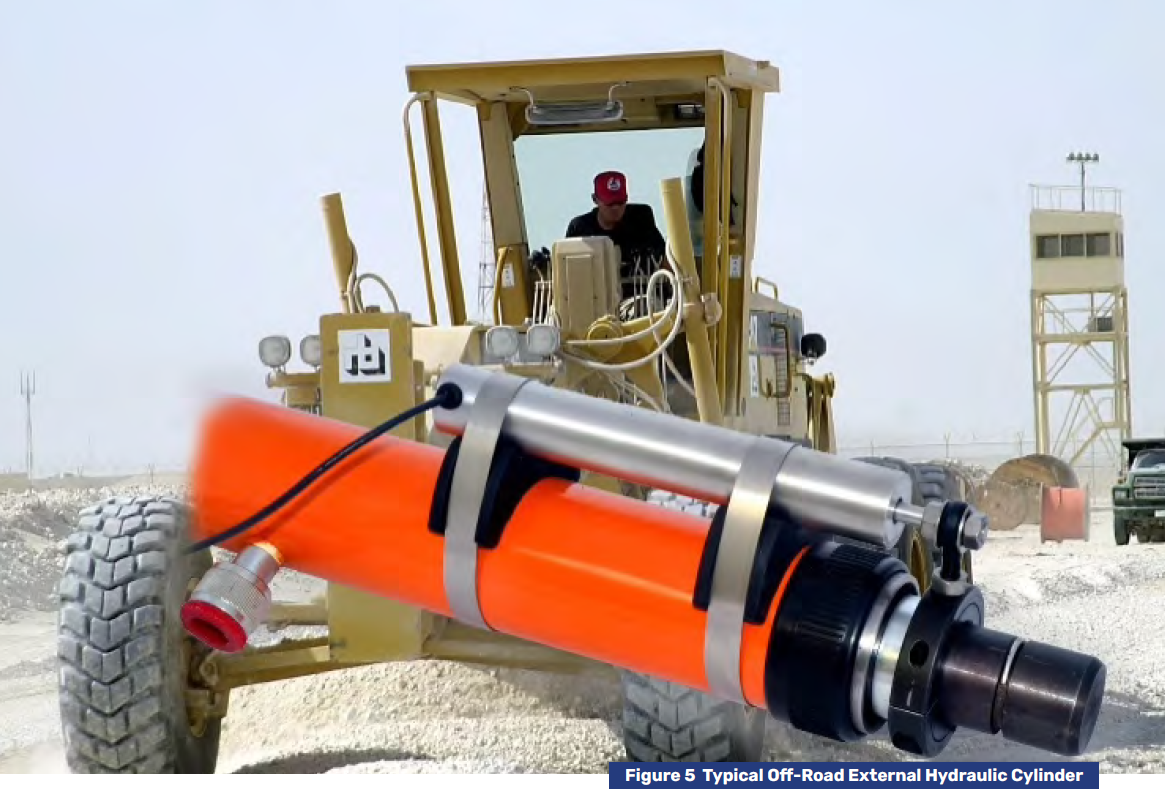
%203.jpeg) In mobile hydraulics, an LVIT is a common choice for measuring a hydraulic cylinder’s ram position. Typically the sensor has a pressure-sealed head and a long probe to insert into a gun-drilled blind hole in the cylinder’s ram. Its target tube is mounted in the blind hole in the ram. The sensor head is either O-ring port-mounted or embedded into the end cap of the cylinder. This packaging version fulfills many different applications in mobile hydraulics such as bulldozer shovel or snow plow positioning, boom positioning on hydraulic cranes and manlift baskets, and for various agricultural vehicle accessory position feedback requirements. A typical externally mounted cylinder LVIT is shown in Figure . LVITs can also be used for second stage spool position feedback in 2-stage servo or proportional valves by having the inductive probe inserted into a blind hole in one end of the valve’s main spool.
In mobile hydraulics, an LVIT is a common choice for measuring a hydraulic cylinder’s ram position. Typically the sensor has a pressure-sealed head and a long probe to insert into a gun-drilled blind hole in the cylinder’s ram. Its target tube is mounted in the blind hole in the ram. The sensor head is either O-ring port-mounted or embedded into the end cap of the cylinder. This packaging version fulfills many different applications in mobile hydraulics such as bulldozer shovel or snow plow positioning, boom positioning on hydraulic cranes and manlift baskets, and for various agricultural vehicle accessory position feedback requirements. A typical externally mounted cylinder LVIT is shown in Figure . LVITs can also be used for second stage spool position feedback in 2-stage servo or proportional valves by having the inductive probe inserted into a blind hole in one end of the valve’s main spool.
%205.jpeg) For off-shore and subsea cylinder applications involving pumps, chokes, blowout preventers, and ROV-based actuators, the LVITs are designed to withstand both the internal and external pressures in a PBOF (pressure balanced, oil-filled) system to ocean depths of 10,000 feet (3,000 m). Other sensor technologies commonly used for these applications often require additional hardware, such as a ring magnet, to be installed, which adds cost to the machining of the cylinder ram and complexity to the sensor’s installation. Typical subsea LVITs are shown in Figure 4.
For off-shore and subsea cylinder applications involving pumps, chokes, blowout preventers, and ROV-based actuators, the LVITs are designed to withstand both the internal and external pressures in a PBOF (pressure balanced, oil-filled) system to ocean depths of 10,000 feet (3,000 m). Other sensor technologies commonly used for these applications often require additional hardware, such as a ring magnet, to be installed, which adds cost to the machining of the cylinder ram and complexity to the sensor’s installation. Typical subsea LVITs are shown in Figure 4.
ADDRESSING CIVIL ENGINEERING CHALLENGES LIKE BRIDGE MOVEMENT AND RAIL BUCKLING
%207.jpeg)
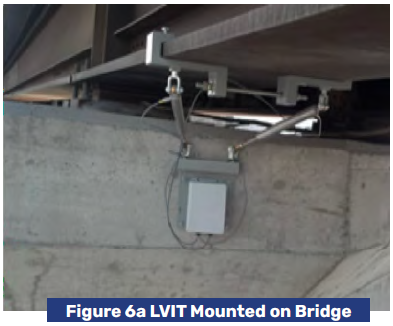 Typical civil engineering and geophysical applications include measuring bridge expansion and contraction due to seasonal heating and cooling, and related shifts in trunnions and roller support mechanisms. This problem of expansion and contraction is compounded with railway bridges and trackage, where the expansion of a mile-long section of rail could be as much as 4 feet over a change of temperature in some climates of 100 degrees F. This could lead to rail buckling, known in the rail transportation industry as “sun kink”, and the subsequent derailment of a train.
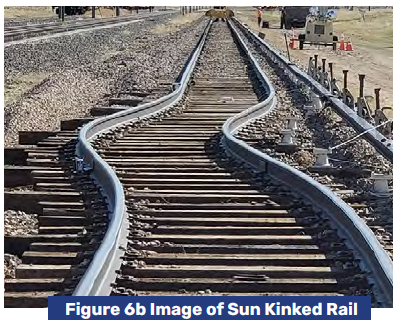 In these applications, instead of having a probe protruding from the sensor head, the LVIT’s probe coil, target, and smart electronics are packaged inside of a shaft-sealed cylindrical housing for protection, allowing the sensor to be exposed to its environment. LVITs are connected to the pier and deck of the bridge to measure their relative position, or directly to the rails to measure rail buckling. This LVIT technology is extremely robust, sealed to IP-67, and can withstand seasonal weather conditions such as heat, cold, rain, and snow. An installation of heavy duty LVITs on a bridge is shown in Figure 6a and sun-kinked railroad tracks are shown in Figure 6b.
DELIVERING PRECISE POSITION FEEDBACK SOLUTIONS FOR POWER GENERATION AND HAZARDOUS LOCATIONS
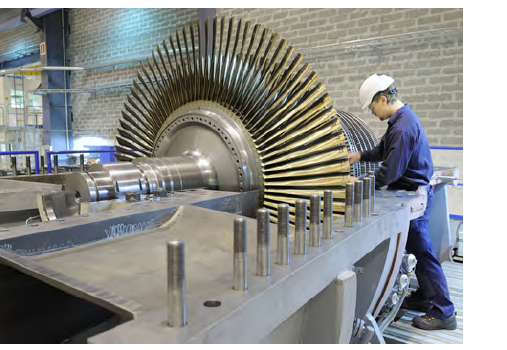
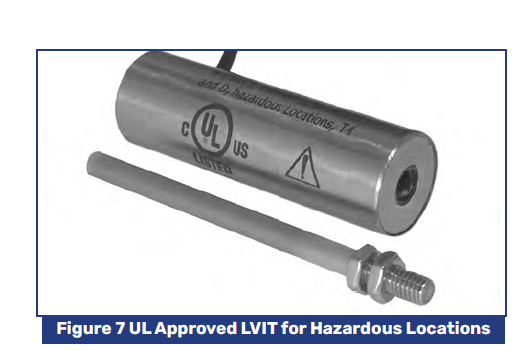
LVITs are being utilized in specific areas of the energy sector. In power generation applications, LVITs are used in systems for steam or fuel valve position feedback, feedwater pump displacement, or power generator shell movement. In oil fields, LVITs are used in hydraulic-operated pumps that replace Lufkin pump jacks and to measure poppet position in oilfield check valves and relief valves. Most oil and natural gas fields are recognized as classic “Hazardous Locations” so ASG produces LVITs that are UL and CUL listed for operation in NEC Class 1, Division 2, Groups C and D hazlocs. This approval is typically accepted in most foreign countries that subscribe to the ATEX hazloc requirements.
ACCURATE LINEAR DISPLACEMENT MEASUREMENT IN LIMITED SPACES
The miniature, high-performance linear position sensor specifically designed for applications where space constraints are a critical factor. Developed for use in compact factory automation systems, precision assembly machinery, and drones, these miniature LVIT sensors offer accurate, contactless position measurement without sacrificing their durability or reliability. The LVIT sensor’s compact form factor and non-contact inductive technology minimize internal wear and mechanical degradation over time, making it ideal for high-duty-cycle environments. Whether used in robotic end effectors, automated tooling, or miniature actuators, this product is engineered to deliver reliable, high-resolution position feedback in space-limited applications.
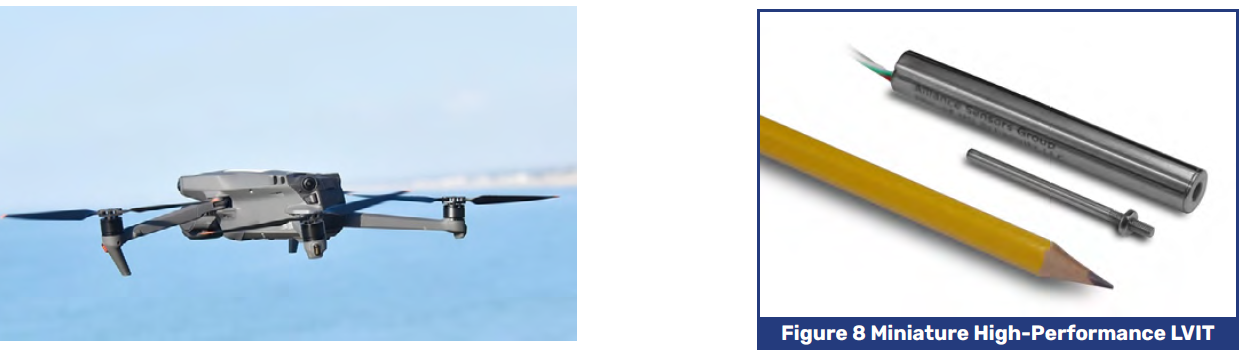
POWERING PRECISION IN ROBOTICS AND AUTOMATION SYSTEMS
%2014.jpeg)
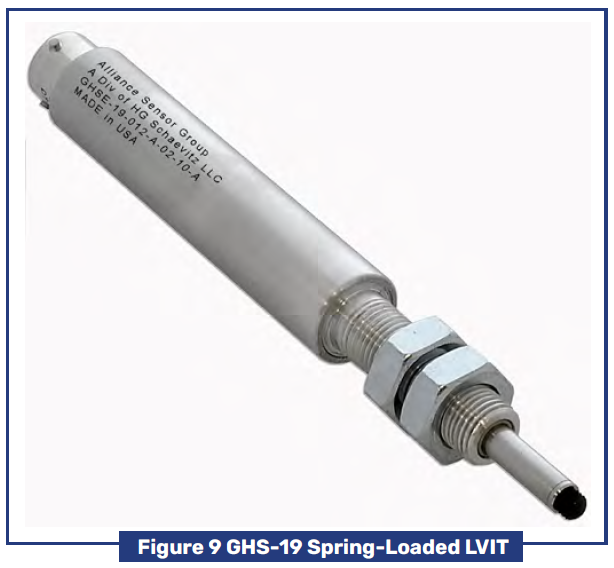 LVITs are used in many factory automation applications, including packaging and material handling equipment, die platen positioning in plastic molding machines, roller position and web tension controls in paper mills or converting facilities, and robotic spray painting or powder-coating systems. While Figure 1 shows a LVIT that is intended to be fastened to the part it is measuring, LVITs can also be spring-loaded as shown in Figure 7. So, where does one use a spring-loaded LVIT versus other spring-loaded sensor technologies such as DC-LVDT gage heads and “pencil” gaging probes?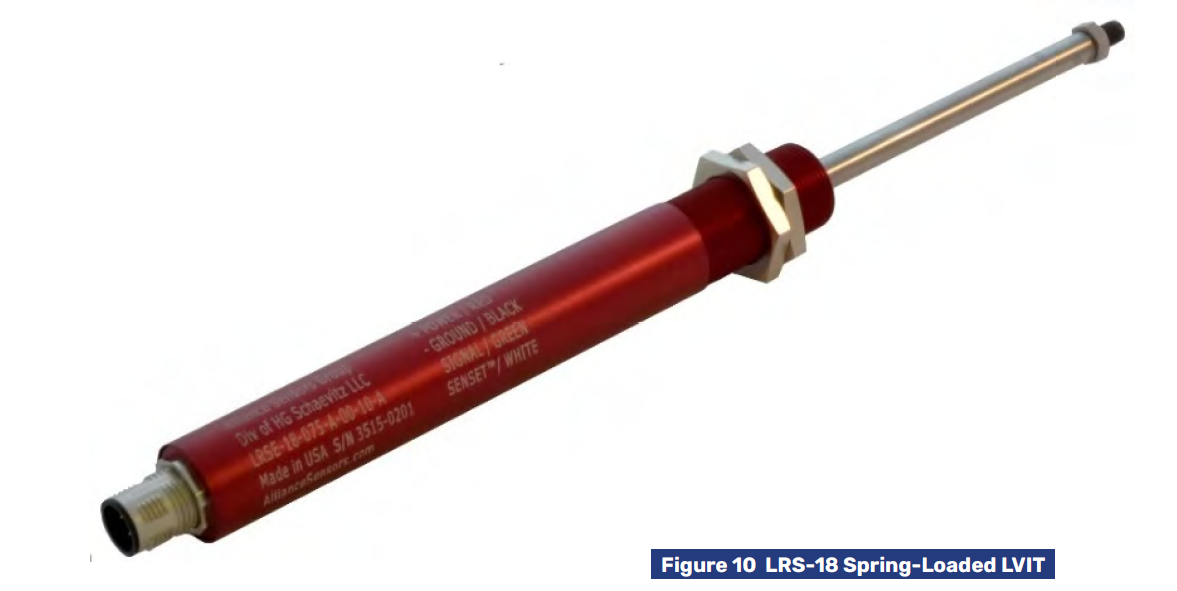
COMPARATIVE SPECIFICATIONS OF COMMON LINEAR POSITION SENSORS
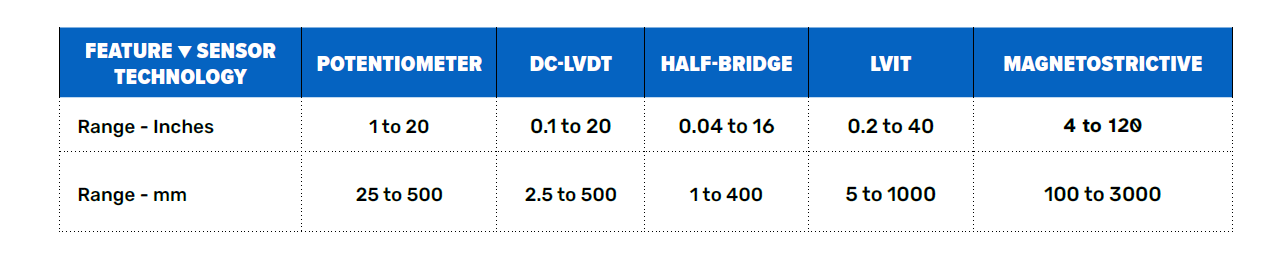
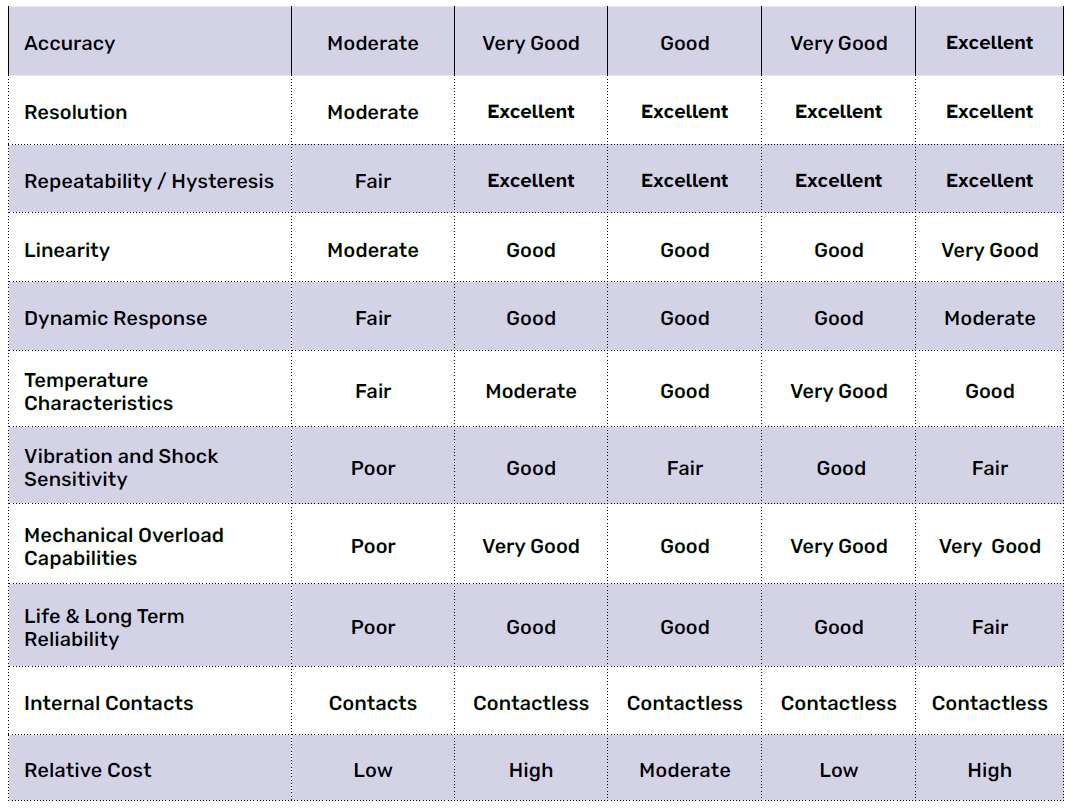
From the foregoing exposition, it is apparent that LVITs represent a valuable and very cost-effective sensing technology for a broad range of position measuring applications. These include fluid power and mobile hydraulics, construction and civil engineering, energy and petroleum exploration, subsea hardware, factory automation systems, and dimensional gaging. The conclusion is that sensors using LVIT technology can solve this wide variety of linear position sensing applications because they offer:
- Exceptional price-to-performance factor
“By switching to your LVITs, we improved system reliability, cut maintenance costs, and enhanced the precision of our automation processes. It was a smart investment with a fast ROI.” --Automation Systems Engineer
- Contactless operation with no wearout
“Thanks to your linear position sensors, we've eliminated position sensor failure as a source of downtime. The contactless design not only improved system reliability but also reduced our long-term maintenance costs.” -- Manufacturing Facility
- Excellent stroke-to-length ratio
“Your sensors offer an exceptional stroke-to-length ratio, allowing us to achieve full-range position sensing with a sensor body significantly shorter than traditional options like LVDTs or magnetostrictive sensors.” -- Packaging Machine Design Engineer
- Extreme robustness to shock and vibration
“These sensors are rugged enough to be mounted directly to bridge structural components like expansion joints and support beams without requiring extra damping or auxiliary housings” -- Civil Engineer
- Excellent linearity, repeatability, and resolution specifications
“In our precision manufacturing operations, accuracy and consistency are non-negotiable. We needed a linear position sensor that could deliver tight linearity, repeatability, and resolution -- without inflating our budget. Your LVIT (Linear Variable Inductive Transducer) sensors exceeded our expectations.” -- Manufacturing Customer
- Multiple analog DC output choices and high resolution digital output
“Multiple analog DC outputs: Our equipment includes a mix of analog controllers, and your LVITs offered the flexibility we required—0–5V, 0–10V, and 4–20mA outputs—allowing us to match each sensor to its respective control system with minimal wiring changes or converters.” -- Operations Engineer
- Temperature compensation over industrial temperature range
“Proven robustness in the field: We deployed these sensors in outdoor and industrial locations where fluid temperature swings are extreme, and they consistently met our stringent accuracy requirements.” -- Hydraulic Technician
- Pressure-sealed versions for fluid power and in-cylinder use
“With your sensors, we’ve enhanced the reliability and safety of our subsea drilling operations while reducing downtime and maintenance costs. For any mission-critical application in extreme environments, these sensors have proven to be an essential part of our system.” -- Platform Drilling Engineer
- Custom application-oriented OEM sensor packages
“As an OEM supplier of oilfield equipment, we needed a sensor solution that exceeded standard, off-the-shelf capabilities. It was essential to partner with a sensor provider who could deliver customized performance without sacrificing reliability or delivery schedules. Your team met that challenge by delivering a UL-approved sensor suitable for hazardous locations.” — Design Engineer
Bibliography
For a detailed reference book on position sensors: Understanding Position Sensors, 7th edition, 2023.
Written by David S. Nyce, published by CRC Press, Boca Raton, FL
In addition to the bibliography in the reference book above, here are more references
• Theory and Design for Mechanical Measurements, 7th Ed. (Figliola, Beasley, Wiley, 2020)
• Handbook of Measurements: Benchmarks for Systems Accuracy and Precision (Badiru, Racz (Eds.),
CRC Press, 2017)
• Mechanical Measurements, 6th Ed. (Pearson, 2007)
• The Condensed Handbook of Measurement and Control, 4th Ed. (ISA, 2025)
• Measurements and their Uncertainties: A practical guide to modern error analysis (Hughes, Hase, OUP,
2010)
• Measurement Systems: Application and Design, 4th Ed. (Doebelin, McGraw-Hill, 1989)
• Modern Instrumentation for Scientists and Engineers (Blackburn, Springer, 2001/2012)
• Fundamentals of Industrial Instrumentation and Process Control, 2nd Ed. (Dunn, McGraw Hill, 2018)
• Sensors, Circuits, and Systems for Scientific Instruments: Fundamentals and Front-Ends, 1st Ed.
(Mandal, Elsevier, 2024)
• Process/Industrial Instruments and Controls Handbook, 4th Ed. (Considine, McGraw-Hill, 1993)
• Linear Position Sensors, Theory and Applications (Nyce, Wiley, 2003)
• Understanding Position Sensors , 7th Ed. (Nyce, CRC Press, 2023)
• Position Sensors (Nyce, Wiley, 2016)
• Fundamentals of Automatic Process Control (Chaudhuri, Chaudhuri, CRC Press, 2012)
• Handbook of Measurement and Control, Revised Ed. (Herceg, Schaevitz Engineering, 1988)