




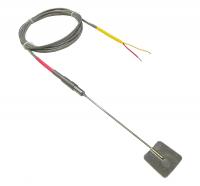
The Weld Pad Surface Temperature Thermocouple Probe is designed for use in industrial applications to measure surface temperature by way of attachment via weld, braze, or clamp. The pad is flexible to form to the contour of a flat or curved surface. The probe is made in the USA with superior materials, designed to withstand even the most rigorous operating conditions.
• Pad material is 304 stainless steel
• Pad dimensions are 1.0" x 1.0" x 0.01" (25mm x 25mm x 0.25mm)
• Pad can be brazed, welded, or clamped to surface
• Stem is flexible
• Type K thermocouple
The Weld Pad Surface Temperature Thermocouple Probe is designed to deliver high performance temperature measurements, reliably and consistently. These temperature sensors are designed for research and development, test labs, manufacturing, engineering and motorsports environments. They can be customized for OEM applications as well.
- - Fast Response
- - Flexible Stainless Steel Pad, Can be Attached to Flat or Curved Surface
- - Pad Can be Brazed, Welded, or Clamped to Surface
- - Inconel 600 Protective Sheathing for Longevity at High Temperatures
- - Stainless Steel Over-braid Signal Cable with PTFE Insulated Conductors; 6 Foot
| Thermocouple Type: | J, K or T |
| Temperature Range: | -148°F to 2192°F range (-100°C to 1200°C) |
| Special Limits of Error Accuracy: | +/- 0.4% of reading |
| Probe Sheath Diameter : | 1/16 inch (0.062 inch) (1.6 mm) |
| Pad Dimensions : | 1.0" x 1.0" x 0.01" (25mm x 25mm x 0.25mm) |
| Pad Material : | 304 Stainless Steel |
| Response Time Constant: | 300 Milliseconds |
We can quickly provide application information, pricing and delivery of these products. Our sales engineers are available to answer your temperature sensor application questions and to help find the right product for you.
Contact us TODAY!
Call 856-727-0250 or e-mail us tempsensors@alliancesensors.com
 Download WPTC-ST Series Weld Pad Thermocouple Datasheet
The weld pad surface temperature thermocouple probe provides a permanent, high-reliability solution for measuring surface temperature in industrial process equipment, heat exchangers, steam piping, and structural monitoring applications. By welding the thermocouple pad directly to the measurement surface, this approach achieves excellent thermal conductivity and minimizes thermal resistance compared to adhesive or mechanically attached sensors.
The welded attachment also provides a durable mechanical bond capable of withstanding vibration, thermal cycling, and flow-induced forces that can dislodge other mounting methods over time.
Welded Attachment vs. Clamped or Adhesive Attachment
The thermal resistance between a surface and a thermocouple junction directly affects measurement accuracy and response time. A welded attachment creates a direct metallurgical bond between the thermocouple and the surface, allowing the junction temperature to closely track the true surface temperature.
In contrast, adhesive or clamped installations introduce an intermediate layer that adds thermal resistance. This can result in slower response times and slightly lower measured temperatures, particularly in applications with rapid thermal changes or steady-state heat flow.
Material Compatibility and Welding Process
Weld pad thermocouples for industrial applications are typically constructed using Type K or Type J thermocouple alloys, with pad materials such as stainless steel or Inconel selected for compatibility with the measurement surface.
The welding process—whether TIG, spot welding, or percussion welding—must produce a clean metallurgical bond without contaminating the thermocouple junction or adversely affecting the base material. Care should be taken to avoid introducing heat-affected zones that could alter the mechanical properties of the surface being measured.
For critical installations, weld quality can be verified with a simple heating test to confirm that the sensor output increases smoothly and consistently as temperature rises.