




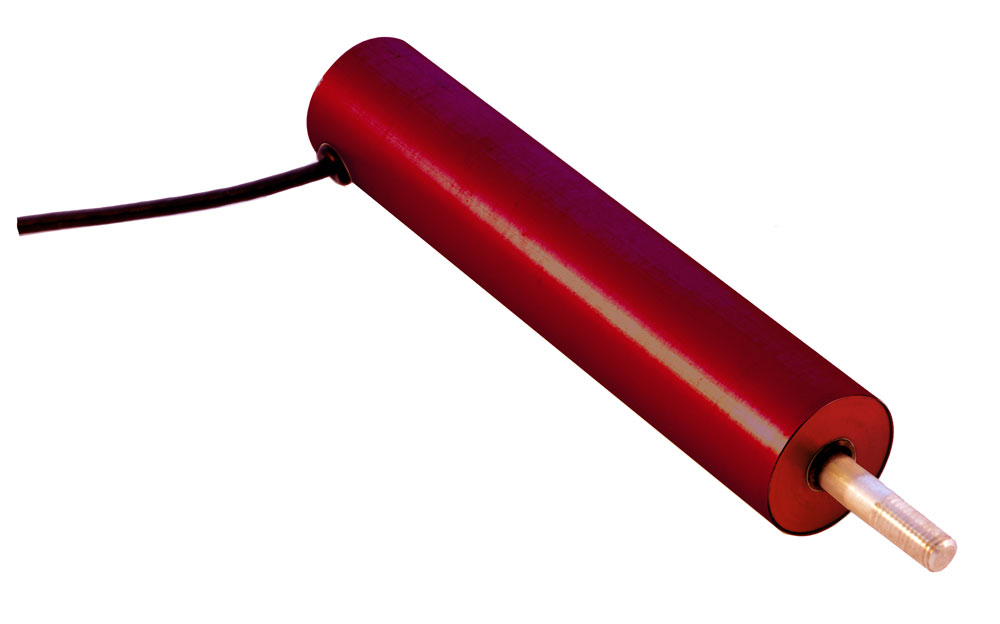
The LZ-25 Series of LVIT (Linear Variable Inductance Transducer) position sensors are contactless devices designed for frictionless measurement in factory automation or assembly machinery applications where space is a premium, as well as for external mounting on hydraulic cylinders to sense rod position.
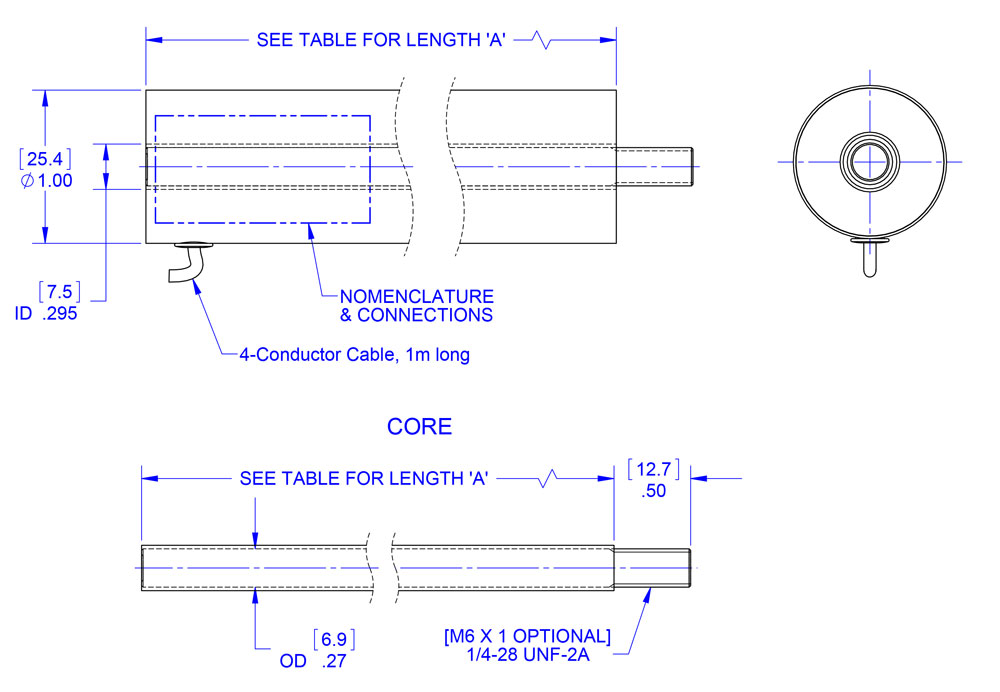
This sensor is offered in nominal full scale ranges from 2 to 36 inches (50 to 900 mm) with an excellent stroke-to-length ratio, so that the sensor's overall length is only 38 mm (1.5 inches) longer than the linear range of the unit. The sensor has a 25.4 mm (1 inch) outside diameter aluminum or optional stainless steel body with a 1 m radial cable for I/O connections. The 7.5 mm (0.295 inch) diameter through-bore of an LZ-25 provides clearance for its 6.35 mm (0.25 inch) diameter moving rod, which is made of the same material as its housing. This through-bore feature also means that the sensor is not subject to damage from typical mechanical overstroking.
For more information see the technical datasheet below.
- - LVIT Technology™ (Linear Variable Inductance Transducer)
- - Contactless Operation...Frictionless Measurement
- - Excellent Stroke-to-Length Ratio
- - Through-bore Design
- - Proprietary SenSet™ Field Adjustable Range Scaling
| Analog I/Os: | 0 – 5 V or 0.5 – 4.5 V DC output; 8 – 30 V input, 35 mA max, 0 – 10 V DC output; 12 – 30 V input, 35 mA max 4 – 20 mA (3-wire) output; 18 – 30 V input, 60 mA max. (75 C max) |
| Measuring Ranges: | 2 to 36 inches (50 to 900 mm) full scale (nominal) |
| Linearity Error: | ±0.15% of Full Scale Output (FSO) typical, ±0.25% max. |
| Resolution: | 0.025% of FSO |
| Update Rate: | 300 Hz nominal |
| Operating Temperature: | -20 to 85 C (-40 to 105 C Extended Range) |
| Temperature Coefficient: | ≤±0.015% of FS/C |
| Vibration: | 5-20 Hz 0.5 inch p-p; 20-2000 Hz 4.2 g p-p |
| Shock: | 1000 g, 11 msec. |
| Terminations: | IEC IP-67 |
| Humidity: | 95% RH, non-condensing |
Electrical Termination | |||||||
|
| Probe | Range | Radial | Termination |
|
|
LZ | X- | XX- | XXX- | X- | XX- | XX- | X- |
| E - Voltage | 25- 25 mm | 050 - 300 | R - Radial | 00 - 1 m cable | 05 - 0.5 to 4.5 VDC | A - Aluminum |
| I - Current |
| (50 mm increments) |
|
| 06 - 4.5 to 0.5 VDC | S - 300 Series SS |
|
|
|
|
|
| 10 - 0 to 10.0 VDC |
|
|
|
| 300 - 450 |
|
| 11 - 10.0 to 0 VDC |
|
|
|
| (75 mm increments) |
|
| 20 - 4 to 20 mA |
|
|
|
|
|
|
| 21 - 20 to 4 mA |
|
|
|
| 450 - 900 |
|
| 50 - 0 to 5 VDC |
|
|
|
| (150 mm increments) |
|
| 51 - 5 to 0 VDC |
|
Wiring Table LZ-25 | ||
Function | Cable Color | |
+ Power Input | Red | |
Ground | Black | |
Analog Output | Green | |
SenSet™ | White | |
LZ-25 Range Table | ||
Nominal Range | Length “A” | |
2.0 inches [50 mm] | 3.00 inches [76.2 mm] | |
4.0 inches [100 mm] | 5.00 inches [127.0 mm] | |
6.0 inches [150 mm] | 7.00 inches [177.8 mm] | |
8.0 inches [200 mm] | 9.25 inches [235.0 mm] | |
10.0 inches [250 mm] | 11.25 inches [285.8 mm] | |
12.0 inches [300 mm] | 13.25 inches [336.6 mm] | |
15.0 inches [375 mm] | 16.50 inches [419.1 mm] | |
18.0 inches [450 mm] | 19.50 inches [495.3 mm] | |
24.0 inches [600 mm] | 25.50 inches [647.7 mm] | |
30.0 inches [750 mm] | 31.50 inches [800.1 mm] | |
36.0 inches [900 mm] | 37.50 inches [952.5 mm] | |
If you are looking for CAD drawings of our LZ-25 sensor, simply call us at 856-727-0250 or use the online contact us form by clicking here.
 Download LVIT Linear Position Sensor LZ-25 Datasheet
What Is the LZ-25 and Why Does Frictionless Sensing Matter?
The LZ-25 is a 25 mm OD LVIT designed for applications where truly frictionless linear position measurement is the primary requirement — servo systems with tight positioning performance budgets, precision test stands where sensor friction would introduce measurement artifacts, and applications where the measured object cannot sustain the side load that a guided sensor would impose. The frictionless designation refers to the complete absence of physical contact between the sensing element (the spoiler) and the sensor body.
How Does Sensor Friction Affect Servo System Accuracy?
Dead Band, Hysteresis, and Positioning Resolution
In any feedback control system, friction in the position sensor introduces a dead band around each target position — the control system must move the actuator far enough to overcome static friction before the sensor output changes, creating a position error that the control system cannot eliminate. A frictionless sensor eliminates this dead band, allowing the servo system to achieve its theoretical positioning resolution rather than a friction-limited approximation of it.
In precision machining, optical alignment, and laboratory automation, the difference between frictionless and low-friction sensing can determine whether the positioning specification is achievable. For engineers designing servo systems where positioning error budgets are measured in microns, the LZ-25’s frictionless operation removes the sensor from the error stack entirely.
LZ-25 vs. Guided-Core Sensors: When Is Frictionless the Right Choice?
Guided-core sensors like the LR-27 use internal bearings to constrain the spoiler’s radial motion, which simplifies installation but introduces a small amount of friction. For most industrial applications — hydraulic cylinder feedback, valve position monitoring, general automation — this friction is negligible and guided-core sensors are the better choice due to their easier installation.
The LZ-25 is the right choice when the application’s performance specification is sensitive to sensor friction: precision servo loops, high-accuracy test stands, laboratory instruments, and systems where the measured object cannot tolerate side loading. In these cases, the additional installation care required by a frictionless sensor is justified by the measurement performance gained.
Installation Requirements for Frictionless LVIT Operation
Alignment Between Sensor Axis and Motion Axis
Achieving truly frictionless operation requires that the spoiler move within the sensor coil without contact — which means the spoiler’s guide mechanism must be provided entirely by the measured object’s motion axis. If the application’s guide mechanism has any lateral slop or backlash, the spoiler may contact the coil bore and introduce the friction that the frictionless design is intended to avoid. Proper alignment between the sensor axis and the motion axis is therefore more critical for the LZ-25 than for sensors with their own guide bearings.
Best Practices for Frictionless Sensor Mounting
• Ensure the measured object’s motion axis provides adequate radial guidance for the spoiler
• Verify that backlash and lateral play in the mechanism are within acceptable limits
• Use alignment fixtures during installation to confirm coaxiality between sensor and motion axis
• Test for spoiler-to-bore contact by monitoring output smoothness during slow-speed traversal
LVIT Advantages for Demanding Position Sensing Applications
Why Engineers Choose LVIT Technology Over Potentiometers and Encoders
LVIT (Linear Variable Inductance Transducer) sensors from Alliance Sensors Group provide a contactless, frictionless measurement principle that eliminates the wear and degradation common in potentiometers while avoiding the quantization artifacts inherent in encoder-based systems. The LZ-25 exemplifies these advantages in applications where measurement integrity directly affects system performance.
Key Performance Characteristics of the LZ-25
• Contactless, frictionless design — no moving parts in contact, delivering long-term repeatability
• Superior stroke-to-length ratio — overall sensor length only slightly exceeds the measurement stroke
• IP67/68 environmental sealing with shock and vibration tolerance
• Operating temperature range of -40°C to 105°C for harsh environment deployment
• Linearity to ≤0.1% FSO with resolution to 0.025% FSO
• SenSet™ field programmability for on-site zero and span adjustment
• DC-in/DC-out operation — no external signal conditioner required
• Low power consumption (<1W) with 250–500 Hz update rates for real-time feedback
For engineers evaluating contactless position sensing options, the LZ-25 delivers performance comparable to LVDTs and magnetostrictive sensors at a lower total cost of ownership, with simpler installation requirements — no ring magnets or complex machining needed.