




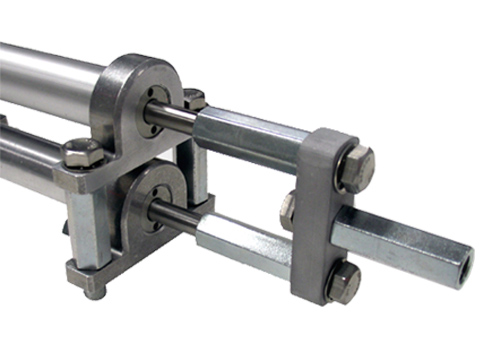
Dual redundancy mounting of the LVDT Position Sensor using GE style mounting configuration.
Need help deciding which product is right for your application? Have questions about a particular product? Speak to an experienced application engineer at H. G. Schaevitz Alliance Sensors Group by calling us at 856-727-0250 or contact us by clicking here.
| : |
 Download GES-HD Drawing
The dual mount stacked LVDT configuration places two independent LVDT sensing elements in a single housing aligned on a common measurement axis, so that both sensors respond to the same mechanical input simultaneously. This configuration is used when the application requires redundant position measurement for safety or reliability purposes — each sensor's output is monitored independently, and a discrepancy between the two indicates a sensor failure that can be flagged before the failed sensor's output corrupts a control loop.
Redundancy in Critical Control Applications
Steam turbine valve position and aircraft flight control actuator position are two applications where single-sensor failure cannot be tolerated. In these systems, redundant sensors allow continued operation on the surviving sensor output while the failed sensor is flagged for replacement, avoiding an emergency shutdown or unscheduled maintenance outage. The stacked configuration is preferable to two separately mounted sensors because it ensures both sensors measure at exactly the same axial position on the core rod — a condition that is difficult to guarantee when sensors are mounted at different locations along the actuator travel.
Signal Conditioner Architecture for Redundant Systems
Stacked LVDT systems typically use two independent signal conditioners, one for each sensing element, with a comparison circuit or logic system that monitors the agreement between the two outputs. The S2A signal conditioner supports this architecture through its RS-485 communications port, which allows a supervisory PLC or DCS to monitor both channels and implement the sensor comparison and fault logic in software rather than requiring dedicated comparison hardware.