




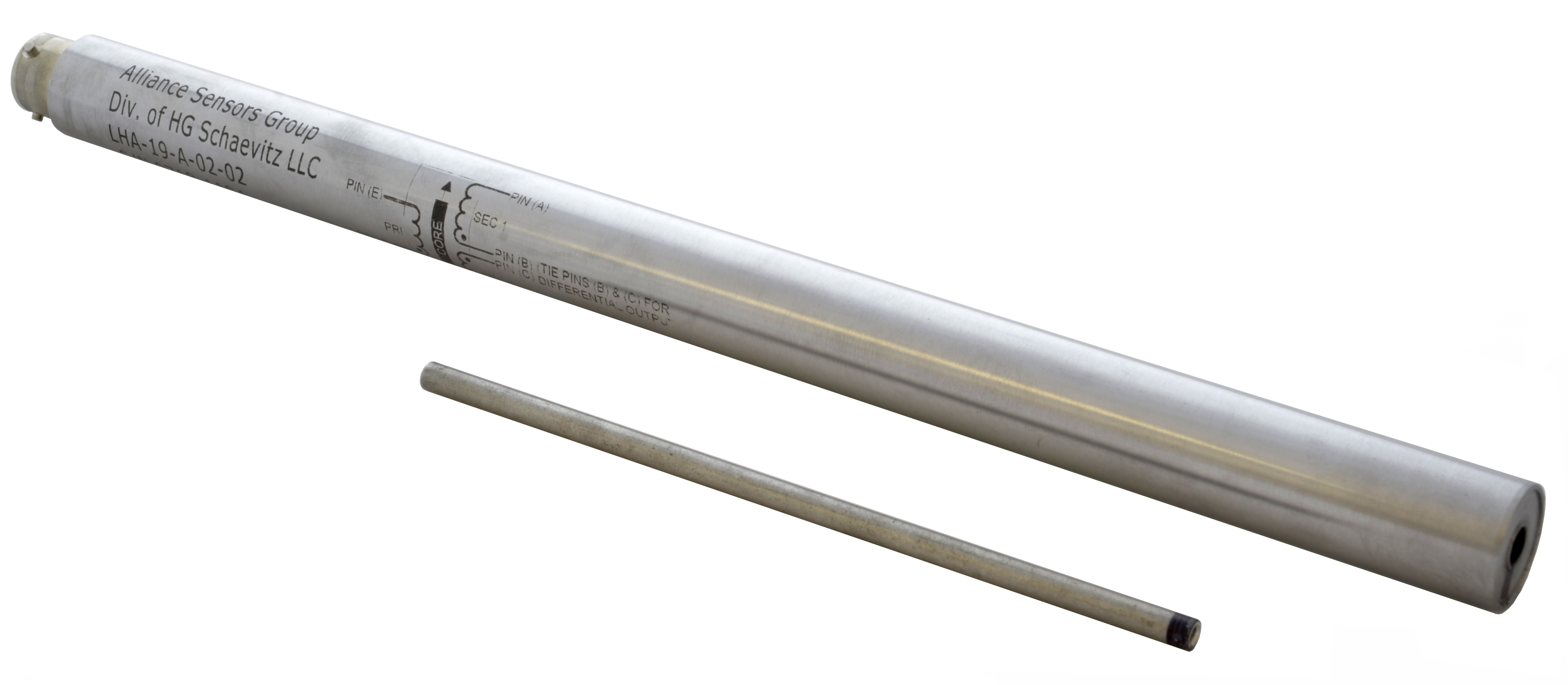
The LHA-19-A series AC-LVDT (Linear Variable Differential Transformer) linear position sensors by H.G. Schaevitz LLC dba Alliance Sensors Group are hermetically sealed, contactless devices designed for industrial and commercial applications, such as: factory automation, metal and paper mills, valve position, robotic assembly systems, pharmaceutical and food processing, and outdoor wet environment applications. These ruggedized linear devices have excellent price-vs-performance and stroke-to-length ratios, making the LHA-19-A AC-LVDT sensors ideal for use in power generation and industrial automation equipment, and many OEM positioning applications.
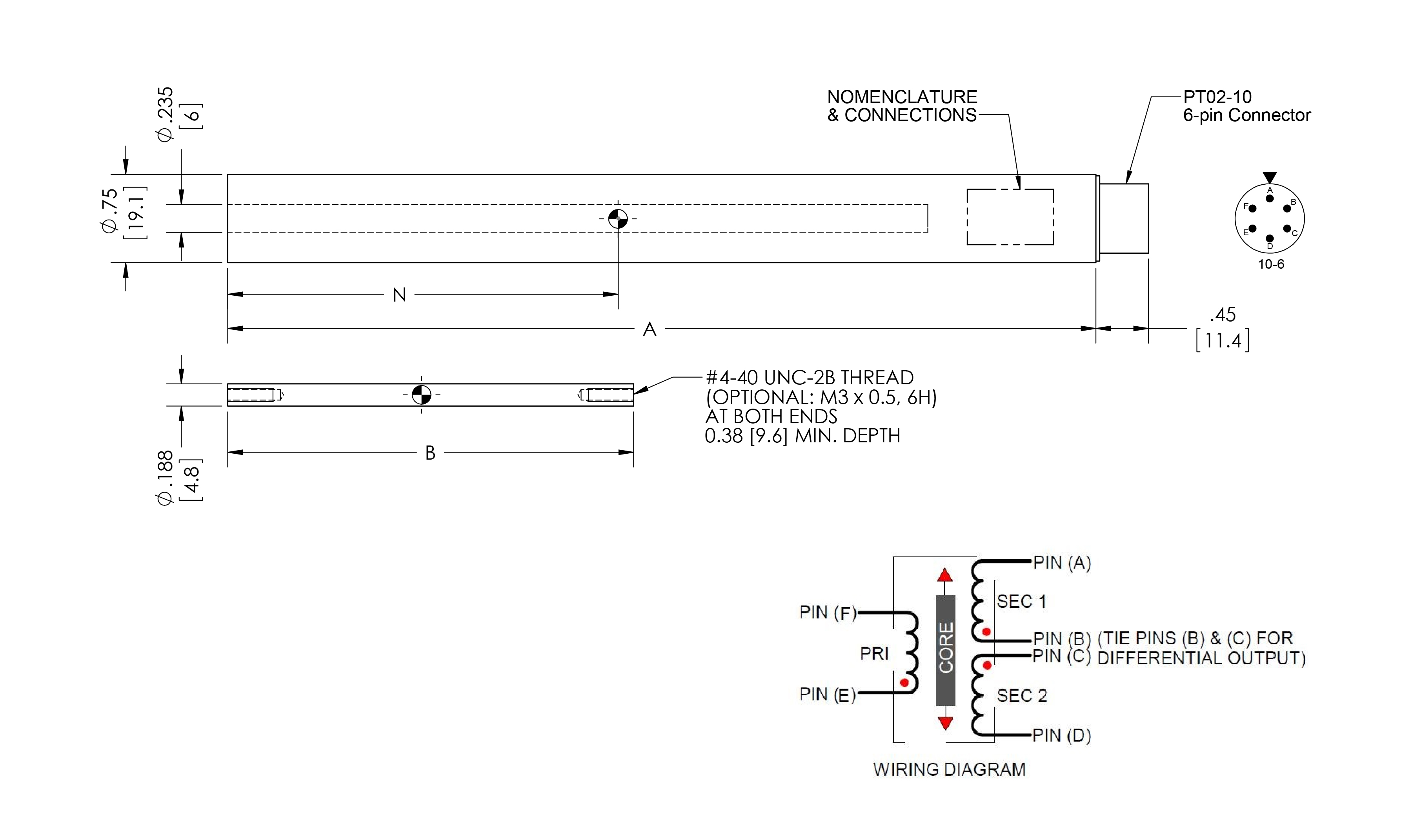
LHA-19-A series AC-LVDTs are offered in 11 ranges from ±.050 to ±10.0 inches (±1.27 to ±254.0 mm) with excellent linearity and infinite resolution. LHA-19-A series AC-LVDTs operate from a nominal 3 Vrms, 2.5 to 3.3 kHz excitation source. They are packaged in a 0.750 inch (19.0 mm) OD SS housing and are offered with either an imperial or metric threaded 0.188 inch (4.8 mm) diameter core, PTO2-10-6P (6-pin) connector, and have a 0.235 inch (6.0 mm) ID for good core-to-bore clearance. They feature a wide operating temperature range.
When mated with ASG’s industrial AC-LVDT DIN-rail-mountable signal conditioner, the LHA-19-A series AC-LVDT becomes part of a complete measurement solution. ASG's AC-LVDTs are also offered in other diameters and longer range versions, including the LA-9.5, LA-19, LA-20.6, LA-21, LA-25, and LA-27.
For more information, see the technical datasheet below.
- - Hermetically Sealed AC-LVDT
- - Welded ¾ Inch OD Stainless Steel Housing
- - Axial PTO2-10-6P (6-pin) Connector
| Available Ranges: | ±0.050, 0.125, 0.250, 0.500, 1.0, 2.0, 3.0, 4.0, 5.0, 7.5, and 10.0 inches |
| Excitation Frequency: | 2.5 to 3.3 kHz |
| Excitation Voltage: | 3.0 V ACrms (nominal) |
| Linearity Error : | ≤±0.25% of FSO (typical 0.15%) |
| Null Voltage: | ≤ 0.05% of FSO |
| Operating Temperature: | -65 to 257 F (-55 to 125 °C ) |
| Temperature Coefficient: | <-0.02% FSO/K |
| Humidity: | 95% RH non-condensing |
| Shock: | 1000 g, 11 msec. |
| Vibration: | 5 - 20 Hz, 0.5 inch p-p; 20 - 2000 Hz, 10g p-p |
Series | Body Diameter | Termination | Bipolar Range (inches) | I/O Connection |
|
LHA | XX- | X- | XXX- | XX | XX |
| 19 - 19 mm (0.75 inch) | A - Axial | 0.05 - ±.050 | 02 - PT02-10-6P (6-pin) | 06 - Metric Threaded Core |
|
|
| 0.125 - ±.125 |
|
|
|
|
| 0.25 - ±.250 |
|
|
|
|
| 0.5 - ±.500 |
|
|
|
|
| 01 - ±1.0 |
|
|
|
|
| 02 - ±2.0 |
|
|
|
|
| 03 - ±3.0 |
|
|
|
|
| 04 - ±4.0 |
|
|
|
|
| 05 - ±5.0 |
|
|
|
|
| 07.5 - ±7.5 |
|
|
|
|
| 10 - ±10.0 |
|
|
PT02-10-6P Connector Wiring Table | |
Pin | I/O Function |
A | Secondary 1 |
B | Secondary 1* |
C | Secondary 2* |
D | Secondary 2 |
E | Primary |
F | Primary |
*Connect pin B to pin C for differential secondary output | |
Nominal Range | Sensitivity | Primary Z | Body Length A | Core Length B | Null Point N | Body Weight | Core Weight |
inches [mm] | mV/V/.001in [mm] | Ohms | inches [mm] | inches [mm] | inches [mm] | oz. [grams] | oz. [grams] |
±0.05 [1.3] | 6.10 [240] | 325 | 2.01 [51.1] | 0.80 [20.3] | 0.63 [16] | 1.6 [45] | 0.08 [2.4] |
±0.12 [3.0] | 3.90 [155] | 735 | 2.64 [67.1] | 1.25 [31.7] | 0.94 [24] | 2.1 [59] | 0.12 [3.7] |
±0.25 [6.3] | 2.40 [96] | 1400 | 3.35 [85.1] | 1.65 [41.9] | 1.32 [33] | 2.5 [71] | 0.18 [4.8] |
±0.50 [12.5] | 0.63 [25] | 1200 | 5.92 [150.4] | 3.45 [87.6] | 2.57 [65] | 3.3 [93] | 0.40 [11.6] |
±1.00 [25] | 0.61 [24] | 1250 | 7.38 [167.5] | 3.45 [87.6] | 3.32 [84] | 4.3 [122] | 0.40 [11.6] |
±2.00 [50] | 0.37 [15] | 2150 | 10.91 [277.1] | 5.30 [314.6] | 5.07 [129] | 6.2 [176] | 0.65 [18.0] |
±3.00 [75] | 0.25 [9.8] | 2150 | 13.85 [346.1] | 6.20 [157.5] | 6.29 [160] | 8.2 [232] | 0.80 [22.0] |
±4.00 [100] | 0.17 [6.7] | 420 | 16.17 [410.7] | 6.20 [157.5] | 7.65 [194] | 9.2 [260] | 0.80 [22.0] |
±5.00 [125] | 0.12 [4.7] | 600 | 18.65 [473.8] | 6.20 [157.5] | 8.94 [227] | 10.0 [283] | 0.80 [22.0] |
±7.50 [190] | 0.11 [4.3] | 775 | 23.85 [605.8] | 7.00 [177.8] | 11.52 [293] | 14.2 [402] | 0.90 [25.5] |
±10.00 [250] | 0.07 [2.8] | 620 | 31.68 [804.7] | 9.50 [241.3] | 15.42 [392] | 18.3 [519] | 1.20 [34.0] |
If you are looking for CAD drawings of our LHA-19-A sensor, simply call us at 856-727-0250 or use the online contact us form by clicking here.
 Download AC-LVDT Position Sensor LHA-19-A Datasheet
How Hermetic Sealing Technology Ensures Measurement Reliability in Impossible Conditions
The LHA-19 Series hermetically sealed AC-LVDT position sensor represents the pinnacle of environmental protection for linear position measurement, delivering highly reliable performance in conditions that destroy conventional sensors within hours. Through advanced hermetic sealing technology borrowed from aerospace and military applications, these sensors operate continuously in corrosive chemicals, high-pressure washdowns, and complete submersion. When standard environmental ratings prove insufficient, the LHA-19 Series provides the ultimate protection for critical position feedback.
Traditional sealing methods using O-rings and gaskets eventually fail when exposed to aggressive chemicals, pressure cycling, or extreme temperatures. The LHA-19's welded hermetic construction creates an impenetrable barrier between internal components and hostile environments. This absolute protection enables measurements in applications previously requiring costly isolation systems or accepting frequent sensor replacement.
Understanding True Hermetic Sealing Versus Standard Protection
Many sensors claim environmental protection through IP ratings, but true hermetic sealing represents a fundamentally different technology level. While IP67-rated sensors resist water spray and temporary immersion, hermetically sealed units survive continuous submersion in aggressive chemicals at elevated temperatures and pressures. The distinction proves critical in applications where seal failure causes immediate sensor destruction.
Hermetic sealing begins with specialized welding processes. Unlike mechanical seals relying on compression, these welds cannot degrade from chemical attack or pressure cycling. Performing helium leak testing verifies seal integrity to levels exceeding aerospace specifications, ensuring decades of protection in the harshest environments.
Advanced Materials for Chemical Compatibility
Material selection proves crucial for surviving aggressive chemical environments. The LHA-19 utilizes specialized stainless steel alloys offering superior corrosion resistance compared to standard grades. Hastelloy and Inconel options provide compatibility with acids, caustics, and exotic chemicals that rapidly attack conventional materials.
Internal components receive additional protection through specialized coatings and encapsulation. High-temperature epoxies rated for chemical exposure protect electrical connections. Ceramic insulators resist chemical penetration while maintaining dielectric properties. These multilayer protection strategies ensure reliable operation even if external housing integrity becomes compromised.
Critical Applications Demanding Hermetic Protection
Chemical processing facilities represent primary applications for hermetically sealed sensors. In pharmaceutical reactors, the LHA-19 monitors agitator positions while submerged in solvents that dissolve conventional seal materials. The inert construction prevents product contamination while surviving cleaning cycles using aggressive sanitizers.
Installation Considerations for Hermetically Sealed Systems
Successfully implementing hermetic sensors requires understanding their unique characteristics. The welded construction prevents field repairs, making proper initial specification critical. Stroke length, mounting configuration, and electrical connections must be defined before manufacturing since modifications aren't possible after hermetic sealing.
Cable entry represents the most vulnerable point in hermetically sealed systems. The LHA-19 employs glass-to-metal sealed connectors maintaining hermetic integrity at the electrical interface. Specialized cable assemblies with molded connectors ensure environmental protection extends throughout the measurement system.
Mounting Strategies for Harsh Environments
Mechanical mounting must complement the sensor's environmental protection. 300 series stainless steel brackets resist corrosion while providing stable support. Isolation mounts prevent vibration transmission in equipment with high mechanical noise. Flexible couplings accommodate misalignment without inducing side loads that could compromise bearing life.
Thermal management deserves consideration in extreme temperature applications. While hermetic sensors survive temperature extremes, thermal gradients can affect measurement accuracy. Insulation or heat sinking strategies maintain uniform sensor temperatures for optimal performance.
Verification and Testing Procedures
Confirming hermetic integrity requires specialized test procedures beyond standard quality checks. Helium mass spectrometry detects leak rates below 1×10^-9 cc/sec, ensuring absolute seal integrity. This testing occurs during manufacturing with documentation provided for quality system requirements.
Field verification focuses on electrical performance since hermetic seals cannot be tested without destruction. Insulation resistance measurements confirm internal component integrity. Monitoring these values over time provides early warning of any environmental intrusion, though properly sealed units maintain specifications for decades.
Long-Term Reliability Data
Field experience validates hermetic sealing effectiveness in extreme applications. Offshore platforms report 15-year continuous operation in saltwater spray environments without degradation. Chemical plants document sensor survival in concentrated acid exposure that dissolves standard housings within days.
Nuclear facilities particularly value hermetic sensors for radiation resistance and absolute containment. The sealed construction prevents radioactive particle intrusion while materials resist radiation degradation. These sensors routinely exceed 40-year design lives in nuclear applications.
Cost Justification for Premium Protection
While hermetically sealed sensors command premium prices, lifecycle analysis demonstrates compelling value in appropriate applications. Eliminating frequent replacements reduces maintenance costs and production interruptions. In hazardous environments, avoiding confined space entries for sensor replacement provides significant safety benefits.
Insurance and regulatory compliance further support hermetic sensor investment. Preventing chemical releases from sensor failures avoids environmental penalties. Reduced maintenance exposure decreases worker compensation costs. These indirect benefits often exceed direct purchase price differentials.
The LHA-19 Series hermetically sealed AC-LVDT represents the ultimate environmental protection for position measurement in extreme conditions. When standard sensors fail repeatedly or applications demand absolute reliability, hermetic sealing provides the only viable solution. Engineers facing the most challenging measurement environments consistently specify the LHA-19 Series, knowing its hermetic protection ensures reliable operation where others cannot survive.