





The LA-9.5 series miniature AC-LVDT (Linear Variable Differential Transformer) linear position sensors by H.G. Schaevitz LLC dba Alliance Sensors Group are contactless devices designed for industrial and commercial applications, such as: factory automation, automotive test stands, solar cell positioners, robotic assembly systems, packaging equipment, and motorsports. Their compact size, superior performance, and excellent stroke-to-length ratio, make the LA-9.5 AC-LVDT sensors ideal for use in test and measurement laboratories, industrial automation equipment, and many OEM position sensing applications.
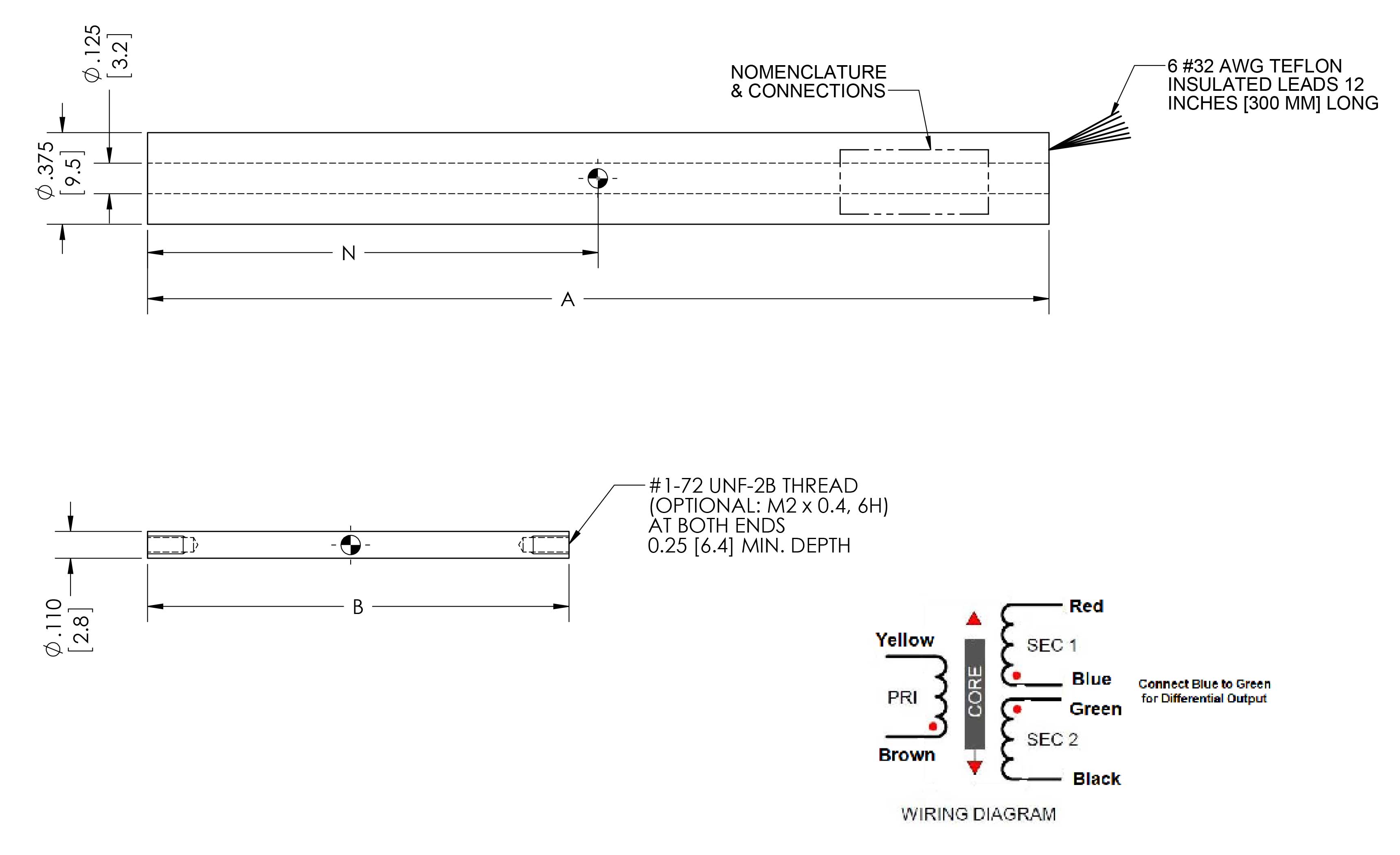
LA-9.5 series AC-LVDTs are offered in 7 ranges from ±0.025 to ±2.0 inches (±0.635 to ±50.8 mm) with excellent linearity and infinite resolution. LA-9.5 series AC-LVDTs operate from a nominal 3 Vrms, 2.5 to 3.3 kHz excitation source. They are packaged in a 0.375 inch (9.5 mm) OD stainless steel housing, come with either a unified or metric threaded 0.110 inch (2.8mm) diameter core, have a 0.125 inch (3.2mm) ID for a reasonable core-to-bore clearance, and feature 12 inch (300 mm) long lead wires. When mated with ASG's industrial AC-LVDT DIN-rail-mountable signal conditioner, an LA-9.5 AC-LVDT becomes part of a complete measurement solution.
ASG's AC LVDTs are also offered in larger body and longer range versions, including the LA-19, LHA-19, LA-21, LA-25, and LA-27.
For more information, see the technical datasheets below.
- - Miniature AC-LVDT
- - 0.375" OD Stainless Steel Housing
| Available Ranges: | ±0.025, 0.050, 0.100, 0.250, 0.500, 1.0, 2.0 inches |
| Excitation Frequency: | 2.5 to 3.3 kHz |
| Excitation Voltage: | 3.0 V ACrms (nominal) |
| Linearity Error: | ≤±0.25% of FSO (typical 0.15%) |
| Null Voltage: | ≤0.05% of FSO |
| Operating Temperature: | -55 to 125 C |
| Temperature Coefficient: | <-0.02% FSO/K |
| Humidity: | 95% RH, non-condensing |
| Shock: | 1000 g, 11 msec. |
| Vibration: | 5 - 20 Hz, 0.5 inch p-p; 20 - 2000 Hz, 10g p-p |
Series | Body Diameter | Termination | Bipolar Range (inches) | I/O Connection |
|
LA | XX- | X- | XXX- | XX | XX |
| 9.5 - 9.5 mm (0.375 inch) | A - Axial | 0.025 - ±.025 | 12 - 12-inch leads | 06 - Metric Threaded Core |
|
|
| 0.05 - ±.050 |
|
|
|
|
| 0.1 - ±.100 |
|
|
|
|
| 0.25 - ±.250 |
|
|
|
|
| 0.5 - ±.500 |
|
|
|
|
| 01 - ±1.0 |
|
|
|
|
| 02 - ±2.0 |
|
|
Nominal Range | Sensitivity | Primary Z | Body Length A | Core Length B | Null Point N | Body Weight | Core Weight |
inches [mm] | mV/V/.001in [mm] | Ohms | inches [mm] | inches [mm] | inches [mm] | oz. [grams] | oz. [grams] |
±0.025 [0.63] | 3.50 [138] | 95 | 0.50 [12.7] | 0.40 [10.2] | 0.25 [6.3] | 0.10 [2.8] | 0.007 [0.23] |
±0.050 [1.3] | 1.70 [67] | 345 | 0.75 [19.1] | 0.60 [15.2] | 0.38 [9.6] | 0.20 [5.7] | 0.014 [0.40] |
±0.100 [2.5] | 1.80 [71] | 345 | 1.00 [25.4] | 0.65 [16.5] | 0.50 [12.7] | 0.21 [6.0] | 0.016 [0.50] |
±0.250 [6.3] | 2.50 [98] | 505 | 1.75 [44.5] | 1.15 [29.3] | 0.88 [22.1] | 0.40 [11.3] | 0.035 [1.00] |
±0.500 [12.7] | 1.70 [67] | 130 | 3.30 [83.8] | 2.00 [50.8] | 1.65 [41.9] | 0.63 [18.0] | 0.056 [1.60] |
±1.000 [25] | 0.75 [30] | 240 | 5.60 [142.2] | 3.00 [76.2] | 2.80 [71.1] | 0.99 [28.0] | 0.092 [2.60] |
±2.000 [50] | 0.50 [20] | 540 | 9.95 [252.7] | 5.30 [134.6] | 4.98 [126.2] | 1.98 [56.0] | 0.183 [5.20] |
If you are looking for CAD drawings of our LA-9.5 sensor, simply call us at 856-727-0250 or use the online contact us form by clicking here.
 Download AC-LVDT Position Sensor LA-9.5 Datasheet
How Miniaturization Advances Enable Precision Sensing in Space-Critical Applications
The LA-95 Series miniature AC-LVDT linear position sensor achieves exceptional measurement accuracy within an ultra-compact 9.5mm diameter housing, solving integration challenges in modern equipment where space constraints previously prevented precision feedback. This miniaturization technology enables engineers to incorporate laboratory-grade position measurement into medical devices, semiconductor equipment, aerospace systems, and advanced automation where every millimeter matters.
Traditional position sensors force design compromises between measurement quality and physical size. The LA-95 Series eliminates these tradeoffs through advanced manufacturing techniques that package full AC-LVDT functionality into housings smaller than a standard pencil. This miniaturization opens new possibilities for equipment designers seeking precision feedback in increasingly compact machines.
Understanding Miniature Sensor Advantages Beyond Size Reduction
While compact dimensions represent the obvious benefit, miniature AC-LVDT sensors provide additional advantages that enhance overall system performance. Reduced moving mass improves dynamic response, enabling accurate measurements at higher frequencies than larger sensors. Lower thermal mass allows faster temperature equilibration, maintaining accuracy in thermally dynamic environments.
The smaller magnetic circuit requires less excitation power, reducing heat generation and power consumption. This efficiency proves critical in battery-powered devices and applications where thermal management challenges system design. Medical equipment manufacturers report 60% power reduction compared to standard-sized sensors while maintaining equivalent accuracy.
Precision Manufacturing Techniques Enabling Miniaturization
Creating functional AC-LVDT sensors at miniature scales demands specialized manufacturing processes. Precision-wound coils utilizing ultra-fine wire achieve required inductance values within minimal volumes. Advanced winding machines maintain consistent tension and spacing despite wire diameters of human hair thickness.
Micro-machining technologies produce mechanical components with tolerances measured in microns. These precision techniques ensure each sensor meets specifications despite dimensional constraints.
Application-Specific Benefits in Advanced Technology Systems
Different industries leverage the LA-95's unique capabilities to enable previously difficult measurements. In medical robotics, these sensors provide position feedback for surgical instruments where larger sensors would obstruct surgeon visibility. The compact size allows multiple sensors within single instruments, enabling complex motion control with unprecedented precision.
Semiconductor manufacturing equipment utilizes LA-95 sensors for wafer pre-positioning with nanometer-scale resolution. The minimal sensor footprint permits installation within vacuum chambers where space commands premium value. Non-magnetic construction options prevent interference with electron beam systems common in advanced lithography.
Integration Strategies for Miniature Sensor Success
Successfully implementing miniature sensors requires attention to mechanical and electrical integration details. Mounting fixtures must provide stable support. Proper mounting techniques prevent measurement errors from thermal expansion mismatches.
Cable management becomes critical with miniature sensors. Flex cables prevent mechanical loading that could affect measurements. Proper strain relief near the sensor connections prevents premature failure from work hardening of the electrical wire conductors. Ultra-flexible cables specifically designed for continuous motion applications ensure reliable operation in dynamic systems.
Signal Conditioning Considerations
Miniature sensors generate smaller signals requiring careful attention to noise management. Low-noise amplifier designs like the SC-200 AC LVDT signal conditioner maximize signal-to-noise ratios while maintaining required bandwidth. Shielding strategies prevent electromagnetic interference from corrupting weak sensor signals.
Digital signal processing techniques extract maximum information from miniature sensor outputs. Oversampling and filtering algorithms improve resolution beyond analog limitations. Temperature compensation algorithms correct for thermal effects more pronounced in small sensor volumes.
Installation Best Practices for Reliable Measurements
Proper installation ensures miniature sensors achieve their full performance potential. Alignment proves especially critical given reduced mechanical tolerances. Precision fixtures and alignment tools are used for proper sensor orientation relative to measured motion axis.
Environmental protection deserves special consideration for miniature sensors. While sealed versions provide IP67 protection, external contamination can still affect exposed moving elements. Bellows or boot seals prevent particle ingress without adding friction that degrades measurement quality.
Calibration Procedures for Miniature Systems
Calibrating miniature sensors requires the same approaches as standard units. For ultra precise calibrations precision micrometers or laser interferometers provide reference standards with appropriate resolution. Output linearization using the appropriate amount of calibration points on the stroke range ensure linearity specifications are met.
Documentation practices become crucial given miniature sensors' sensitivity to installation variables. Recording mounting torques, cable routing, and environmental conditions enables consistent results across multiple installations. Digital photographs supplement written documentation for complex assemblies.
Emerging Applications Enabled by Miniaturization
Advancing technology continuously creates new applications for miniature position sensors. Wearable medical devices incorporate LA-95 sensors for joint motion analysis and prosthetic control. Micro-satellite actuators utilize these sensors for precise positioning despite challenging size and weight constraints.
Consumer electronics increasingly demand precision feedback for haptic systems and camera stabilization. The LA-95's combination of accuracy, size, and reliability meets these challenging requirements while supporting high-volume production demands.
The LA-95 Series miniature AC-LVDT represents a convergence of precision engineering, advanced materials, and innovative manufacturing that enables position measurement where space constraints previously made it impossible. As equipment continues shrinking while performance demands increase, these ultra-compact sensors provide the critical feedback necessary for next-generation technology advancement. Engineers pushing miniaturization boundaries consistently specify LA-95 sensors, knowing they deliver laboratory-grade precision in impossibly small packages.