




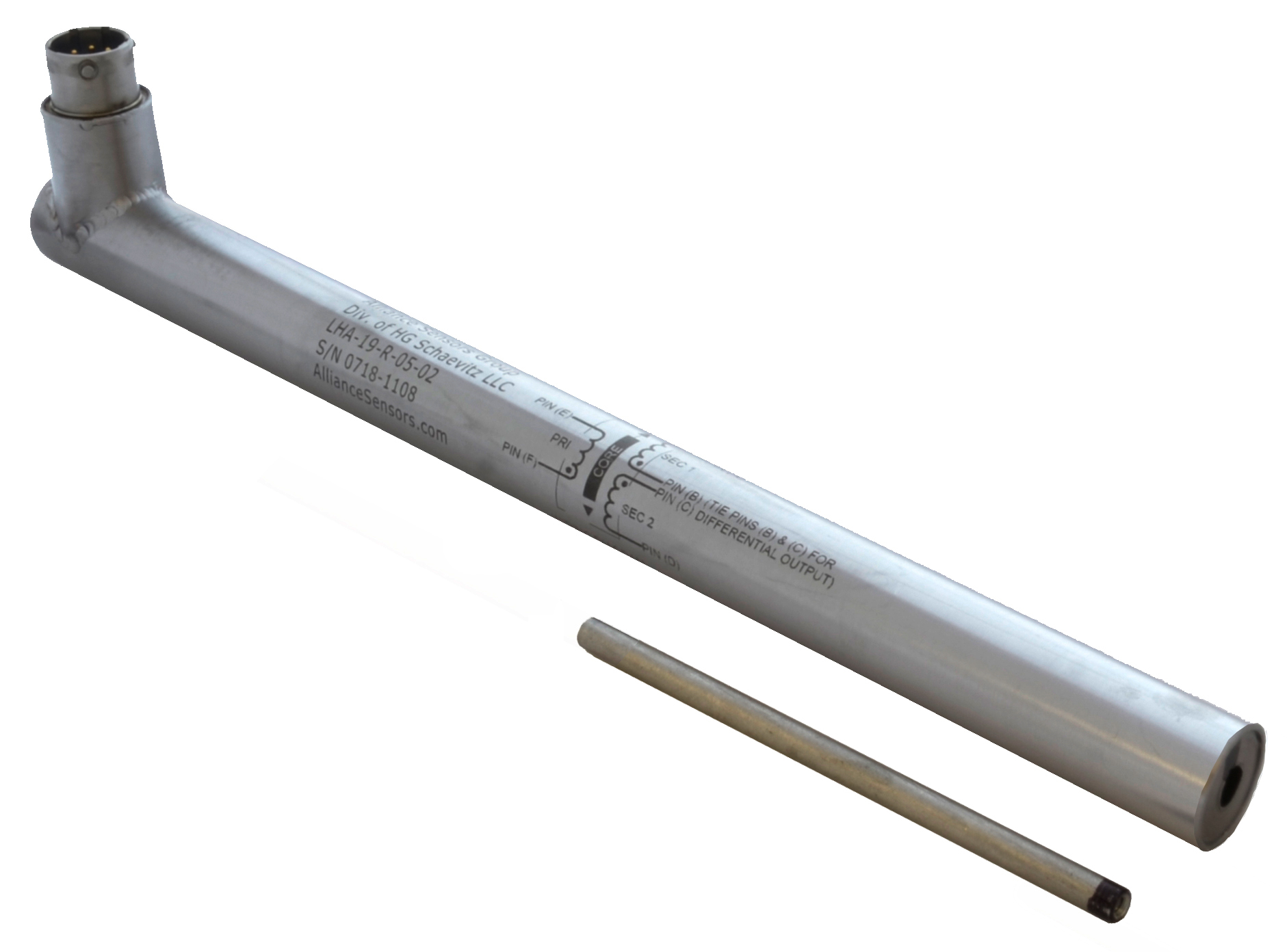
The LHA-19-R series AC-LVDT (Linear Variable Differential Transformer) linear position sensors by H.G. Schaevitz LLC dba Alliance Sensors Group are hermetically sealed, contactless devices with a radial connector, designed for industrial and commercial applications, such as: factory automation, metal and paper mills, valve position, robotic assembly systems, pharmaceutical and food manufacturing, and wet environment applications. These ruggedized linear devices have excellent price-vs-performance and stroke-to-length ratio, making LHA-19-R AC-LVDT sensors ideal for use in power generation and industrial automation equipment, and many OEM positioning applications.
LHA-19-R series AC-LVDTs are offered in 12 ranges from ±.050 to ±10.0 inches ( ±1.27 to ±254.0 mm) with excellent linearity and infinite resolution. LHA-19-R series AC-LVDTs operate from a nominal 3 Vrms, 2.5 to 3.3 kHz excitation source. They are packaged in a 0.750 inch (19.0 mm) OD SS housing and are offered with either an imperial or metric threaded 0.188 inch (4.8 mm) diameter core, a radial PTO2-10-6P (6-pin) connector, and have a 0.235 inch (6.0 mm) ID for good core-to-bore clearance. These sensors feature a wide operating temperature range.
When mated with ASG’s industrial AC-LVDT DIN-rail-mountable signal conditioner, an LHA-19-R series AC-LVDT becomes part of a complete measurement solution especially when space comes at a premium. ASG's AC-LVDTs are also offered in larger and smaller body and longer range versions, including the LA-9.5, LA-19, LA-20.6, LA-21, LA-25, and LA-27.
For more information, see the technical datasheets below.
- - Hermetically Sealed AC-LVDT
- - Through-Bore Design
- - Welded ¾ Inch OD Housing with Radial Connector
- - Sealed to IP-69
| Available Ranges: | ±0.050, 0.125, 0.250, 0.500, 1.0, 2.0, 3.0, 4.0, 5.0, 6.0, 7.5, and 10.0 inches |
| Excitation Frequency: | 2.5 to 3.3 kHz |
| Excitation Voltage: | 3.0 V ACrms (nominal) |
| Linearity Error : | ≤±0.25% of FSO (typical 0.15%) |
| Null Voltage: | ≤0.05% of FSO |
| Operating Temperature: | -65 to 257°F (-55 to 125 C ) |
| Temperature Coefficient: | <-0.02% FSO/degree K |
| Humidity: | 95% RH non-condensing |
| Shock: | 1000 g, 11 msec |
| Vibration: | 5 - 20 Hz, 0.5 inch p-p; 20 - 2000 Hz, 10g p-p |
Series | Body Diameter [mm] | Termination | Bipolar Range (inches) | I/O Connection |
|
LHA | XX- | X- | XXX- | XX | XX |
| 19 - 19 mm (0.75 inch) | R - Radial | 0.05 - ±.050 | 02 - PT02-10-6P (6-pin) | 06 - Metric Threaded Core |
|
|
| 0.125 - ±.125 |
|
|
|
|
| 0.25 - ±.250 |
|
|
|
|
| 0.5 - ±.500 |
|
|
|
|
| 01 - ±1.0 |
|
|
|
|
| 02 - ±2.0 |
|
|
|
|
| 03 - ±3.0 |
|
|
|
|
| 04 - ±4.0 |
|
|
|
|
| 05 - ±5.0 |
|
|
|
|
| 06 - ±6.0 |
|
|
|
|
| 07.5 - ±7.5 |
|
|
|
|
| 10 - ±10.0 |
|
|
PT02-10-6P Connector Wiring Table | |
Pin | I/O Function |
A | Secondary 1 |
B | Secondary 1* |
C | Secondary 2* |
D | Secondary 2 |
E | Primary |
F | Primary |
*Connect pin B to pin C for differential secondary output | |
Nominal Range | Sensitivity | Primary Z | Body Length A | Core Length B | Null Point N | Body Weight | Core Weight |
inches [mm] | mV/V/.001in [mm] | Ohms | inches [mm] | inches [mm] | inches [mm] | oz. [grams] | oz. [grams] |
±0.05 [1.3] | 6.10 [240] | 325 | 2.01 [51.1] | 0.80 [20.3] | 0.63 [16] | 1.6 [45] | 0.08 [2.4] |
±0.12 [3.0] | 3.90 [155] | 735 | 2.64 [67.1] | 1.25 [31.7] | 0.94 [24] | 2.1 [59] | 0.12 [3.7] |
±0.25 [6.3] | 2.40 [96] | 1400 | 3.35 [85.1] | 1.65 [41.9] | 1.32 [33] | 2.5 [71] | 0.18 [4.8] |
±0.50 [12.5] | 0.63 [25] | 1200 | 5.92 [150.4] | 3.45 [87.6] | 2.57 [65] | 3.3 [93] | 0.40 [11.6] |
±1.00 [25] | 0.34 [13.4] | 785 | 7.38 [167.5] | 3.45 [87.6] | 3.32 [84] | 4.3 [122] | 0.40 [11.6] |
±2.00 [50] | 0.20 [8.0] | 575 | 10.91 [277.1] | 5.30 [134.6] | 5.07 [129] | 6.2 [176] | 0.65 [18.0] |
±3.00 [75] | 0.23 [9.0] | 1200 | 13.85 [346.1] | 6.20 [157.5] | 6.29 [160] | 8.2 [232] | 0.80 [22.0] |
±4.00 [100] | 0.17 [6.7] | 420 | 16.17 [410.7] | 6.20 [157.5] | 7.65 [194] | 9.2 [260] | 0.80 [22.0] |
±5.00 [125] | 0.12 [4.7] | 600 | 18.65 [473.8] | 6.20 [157.5] | 8.94 [227] | 10.0 [283] | 0.80 [22.0] |
±6.00 [150] | 0.11 [4.3] | 500 | 18.65 [473.8] | 5.30 [134.6] | 8.94 [227] | 10.0 [283] | 0.65 [18.0] |
±7.50 [190] | 0.11 [4.3] | 775 | 23.85 [605.8] | 7.00 [177.8] | 11.52 [293] | 14.2 [402] | 0.90 [25.5] |
±10.00 [250] | 0.07 [2.8] | 620 | 31.68 [804.7] | 9.50 [241.3] | 15.42 [392] | 18.3 [519] | 1.20 [34.0] |
If you are looking for CAD drawings of our LHA-19-R sensor, simply call us at 856-727-0250 or use the online contact us form by clicking here.

 Download AC-LVDT Position Sensor LHA-19-R Datasheet
Why Combining Hermetic Sealing with Remote Electronics Solves the Toughest Measurement Challenges
The LHA-19-R Series hermetically sealed AC-LVDT combined with remote electronics represents the ultimate solution for position measurement in environments that are both spatially constrained and environmentally hostile. By combining impenetrable hermetic sealing with separated signal conditioning electronics, this design enables precise measurements in applications where standard sensors fail from either environmental exposure or space limitations. Chemical processing, nuclear facilities, and subsea installations particularly benefit from this dual-protection architecture.
When corrosive environments coincide with high temperatures or confined spaces, traditional sensor options force unacceptable compromises. The LHA-19-R eliminates these tradeoffs by placing only the hermetically sealed sensing element in the hostile environment while electronics reside in protected locations. This separation strategy maximizes both reliability and maintainability in the world's most challenging applications.
Understanding Synergies Between Hermetic and Remote Technologies
The combination of hermetic sealing and remote electronics creates capabilities exceeding either technology alone. Hermetic protection ensures the sensing element survives chemical attack, pressure extremes, and contamination. Remote electronics enable operation in temperature ranges that would destroy integrated components while providing access for maintenance without entering hazardous areas.
This design proves especially valuable in radioactive environments. The hermetically sealed coil assembly withstands radiation exposure and contamination while sensitive electronics remain outside shielded areas. Nuclear facilities report dramatic reductions in maintenance exposure and electronic component replacement costs using this configuration.
Temperature Range Extension Through Separation
High-temperature applications particularly benefit from remote electronics architecture. While the hermetic coil assembly survives temperatures exceeding 500°F, electronic components fail above 250°F. Separating these elements enables measurements in furnaces, reactors, and steam systems impossible with integrated sensors.
The temperature separation also improves measurement stability. Electronics operating in controlled environments maintain calibration better than units experiencing thermal cycling. This stability translates to extended calibration intervals and improved process control in critical applications.
Space Optimization in Confined Installations
Hermetically sealed sensors typically require larger housings than standard units due to welded construction requirements. The remote configuration minimizes space consumption at the measurement point by relocating bulky electronics. This proves crucial in packed equipment where every millimeter matters.
Critical Applications Requiring Dual Protection
Chemical batch reactors exemplify applications demanding both hermetic sealing and remote electronics. The sensing element mounts inside vessels containing aggressive chemicals at elevated temperatures while electronics remain in climate-controlled panels. This configuration survives reaction conditions that destroy conventional sensors while maintaining precise level or agitator position control.
Subsea oil and gas applications leverage both technologies for different reasons. Hermetic sealing prevents seawater intrusion at depth while remote electronics facilitate topside maintenance without recovering subsea equipment. The extreme costs of subsea intervention make this reliability enhancement economically compelling despite higher initial investment.
Installation Strategies for Arrayed Systems
Successfully implementing hermetically sealed sensors with remote electronics requires careful system design. Cable runs between components must maintain environmental protection while minimizing signal degradation. Specialized interconnect systems using hermetically sealed connectors ensure protection continuity throughout the measurement chain.
Grounding strategies become critical with separated components. Single-point grounding prevents ground loops while proper shielding rejects electromagnetic interference. In high-EMI environments, twisted shielded pairs or triaxial cables provide superior noise immunity compared to standard instrumentation cables.
Cable Selection for Extreme Environments
The cable connecting hermetic sensors to remote electronics often faces the same hostile environment as the sensor itself. Chemical-resistant jacketing materials like PTFE or PEEK survive exposure that destroys PVC or polyurethane. Armored constructions prevent mechanical damage in high-traffic areas.
Temperature ratings must match application requirements throughout the cable path. High-temperature fiberglass insulation near the sensor transitions to more flexible materials in moderate temperature zones. This graduated approach optimizes performance while controlling costs.
Junction Box Considerations
Intermediate junction boxes sometimes prove necessary in long cable runs or complex routing situations. These enclosures must maintain the environmental protection level of connected components. Explosion-proof ratings may be required in hazardous areas.
Maintenance Advantages of Separated Architecture
The remote electronics configuration dramatically simplifies maintenance procedures in hazardous environments. Electronic modules can be tested, calibrated, or replaced without entering confined spaces or contaminated areas. This capability reduces maintenance costs while improving worker safety.
Predictive maintenance strategies work particularly well with remote electronics. Continuous monitoring of coil resistance and signal quality from accessible locations identifies developing problems before failure. This early warning capability prevents unexpected shutdowns in critical processes.
Calibration Procedures for Arrayed Systems
Calibrating sensors with remote electronics requires modified procedures accounting for cable effects. End-to-end system calibration using precision mechanical standards ensures accuracy at the measurement point rather than just electronic verification. Temperature compensation may require characterization at multiple operating points.
Documentation requirements increase with arrayed architectures. Recording cable types, lengths, and routing enables accurate troubleshooting. Maintaining separate calibration records for sensing elements and electronics modules supports targeted maintenance when performance degrades.
Economic Justification Through Lifecycle Analysis
The premium cost of hermetically sealed sensors with remote electronics requires careful economic analysis. In applications with extreme replacement costs, such as subsea or nuclear installations, the investment pays back quickly. Avoided production losses from unexpected failures often justify the technology in less extreme applications.
Safety considerations provide additional justification. Reducing confined space entries and hazardous area exposure has measurable value through decreased insurance costs and regulatory compliance. These soft benefits combined with hard maintenance savings typically demonstrate compelling returns on investment.
The LHA-19-R Series hermetically sealed AC-LVDT with remote electronics represents the ultimate position sensing solution for applications combining environmental extremes with installation constraints. This dual-technology approach enables measurements previously considered impossible while improving maintainability and safety. Engineers facing the most challenging measurement applications consistently specify the LHA-19-R Series, knowing its unique capabilities solve problems no other sensor can address.