




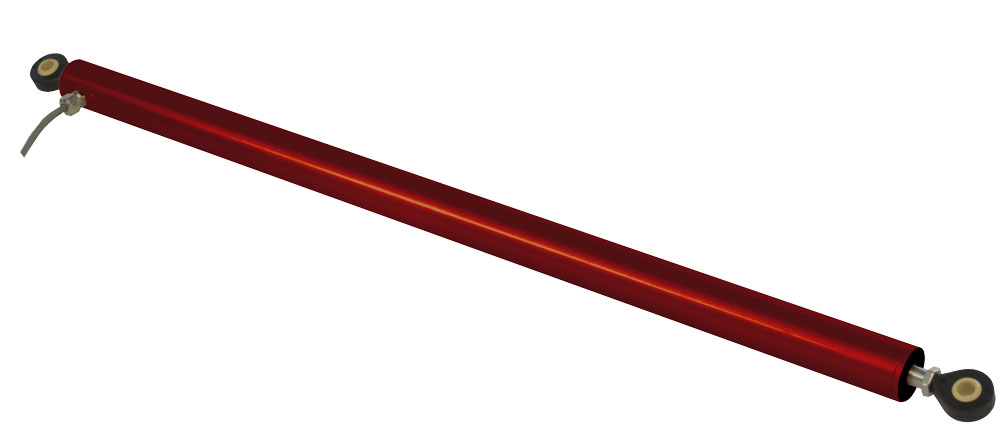
Alliance Sensor Group's LRL-27 series LVIT (Linear Variable Inductance Transducer) contactless position sensors complement the LR series with extended ranges up to 18 inches (450 mm) in a compact package. These sensors are designed for use in factory automation systems and a wide variety of industrial and commercial applications. Cost effective with high-end performance and excellent stroke-to-length ratios make these sensors ideal choices for many industrial application.
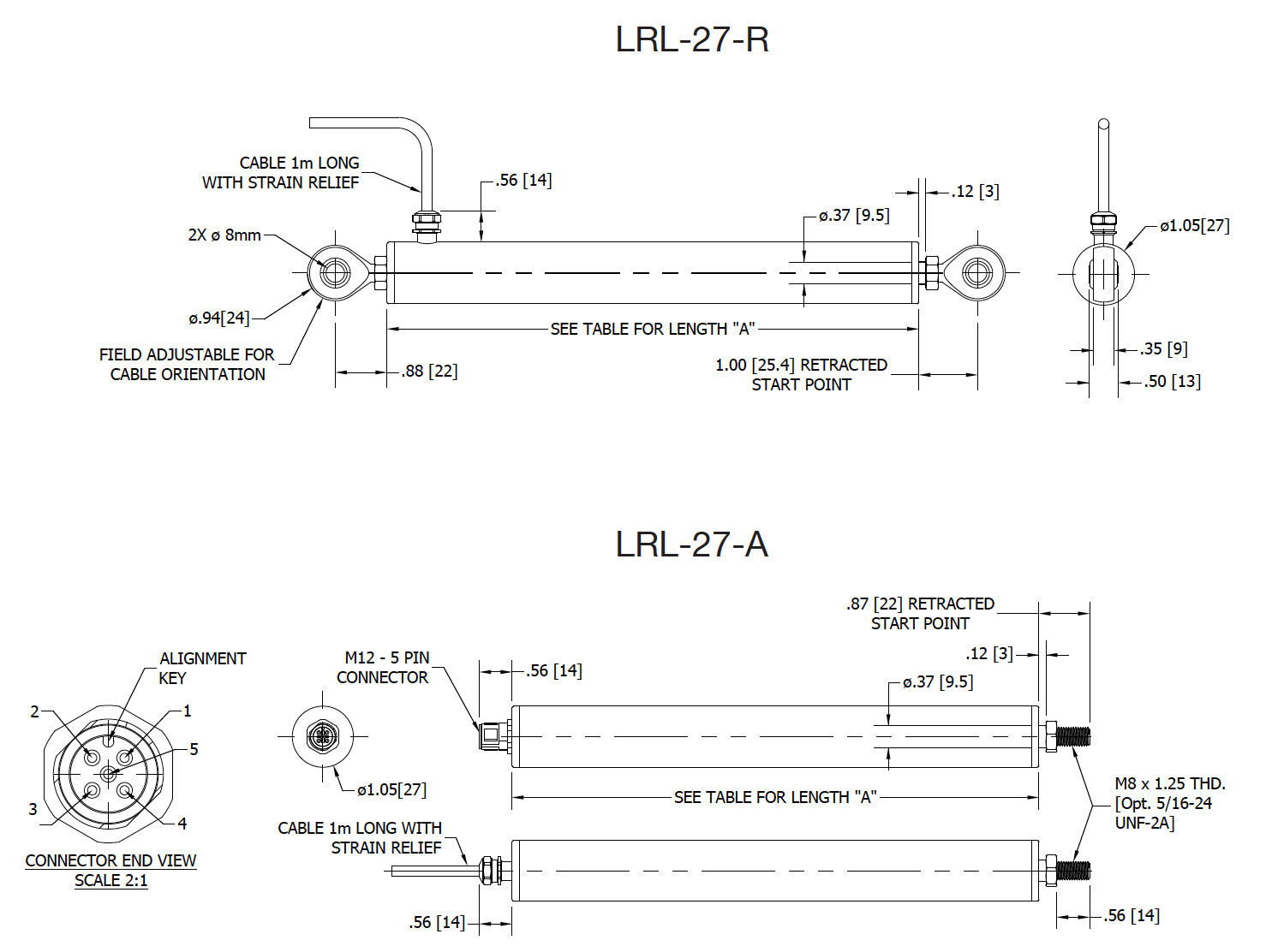
LRL-27 sensors are offered in 6 nominal ranges from 8 to 18 inches (200 to 450 mm). Operated from a variety of DC voltages, these sensors offer the end-user a choice of four analog outputs along with ASG's proprietary SenSet™ field adjustable range scaling feature. LRL-27 sensors are available with either a radial exiting cable and two spherical rod eye ends or with an axial cable or connector terminations.
The LR series also has a smaller body version, the LR-19, for applications where a reduced body envelope is required or the LR-27 for shorter stroke lengths from 25 to 150 mm.
Technical datasheets and additional information can be found below.
- - LVIT Technology™ (Linear Variable Inductance Transducer)
- - Contactless Operation
- - Excellent Stroke-to-Length Ratio
- - Proprietary SenSet™ Field Adjustable Range Scaling
| Analog I/Os: | 0 – 5 V or 0.5 – 4.5 V output with 8 – 30 V input, 35 mA max. 0 – 10 V output with 12 – 30 V input, 35 mA max. 4 – 20 mA (3-wire) output with 18 – 30 V input, 60 mA max. (75 C max.) |
| Measuring Ranges: | 200 mm to 450 mm (8 to 18 inches) full scale (nominal) |
| Linearity Error: | ±0.15% of Full Scale Output (FSO) typical, ±0.25% max. |
| Resolution: | 0.025% of FSO |
| Update Rate: | 300 Hz nominal |
| Operating Temperature: | -20 C to 85 C (-40 C to 105 C Extended Range) |
| Temperature Coefficient: | ≤±0.015% of FS/deg C |
| Vibration: | 5-20 Hz 0.5 inch p-p; 20-2000 Hz 4.2 g p-p |
| Shock: | 1000 g, 11 msec. |
| Terminations: | IEC IP-67 |
| Humidity: | 95% RH, non-condensing |
Electrical Termination | |||||||
|
| Probe | Range | Axial | Termination |
|
|
LRL | X- | XX- | XXX- | X- | XX- | XX- | X- |
| E - Voltage | 27- 27 mm | 200 | A - Axial | 00 - 1 m cable | 05 - 0.5 to 4.5 V | A - Aluminum |
| I - Current |
| 250 | R - Radial (cable only) | 01 - 5-pin M12 | 06 - 4.5 to 0.5 V | S - 300 Series SS |
|
|
| 300 |
|
| 10 - 0 to 10.0 V |
|
|
|
| 350 |
|
| 11 - 10.0 to 0 V |
|
|
|
| 400 |
|
| 20 - 4 to 20 mA |
|
|
|
| 450 |
|
| 21 - 20 to 4 mA |
|
|
|
|
|
|
| 50 - 0 to 5 V |
|
|
|
|
|
|
| 51 - 5 to 0 V |
|
Wiring Table LRL-27-A | ||
Function | M-12 Pin | Cable Color |
+ Power input | 1 | Red |
Ground | 2 | Black |
Voltage output | 3 | Green |
Current output | 4 | Green |
SenSet™ | 5 | White |
Wiring Table LRL-27-R | ||
Function | Cable Color | |
+ Power input | Red | |
Ground | Black | |
Analog output | Green | |
SenSet™ | White | |
Unit Length Table | ||
Linear Range | Length “A” | |
8.0 inches [200 mm] | 11.50 inches [292.1 mm] | |
10.0 inches [250 mm] | 13.50 inches [342.9 mm] | |
12.0 inches [300 mm] | 15.50 inches [393.7 mm] | |
14.0 inches [350 mm] | 17.50 inches [444.5 mm] | |
16.0 inches [400 mm] | 19.50 inches [495.3 mm] | |
18.0 inches [450 mm] | 21.50 inches [546.1 mm] | |
If you are looking for CAD drawings of our LRL-27 sensor, simply call us at 856-727-0250 or use the online contact us form by clicking here.
 Download LVIT Linear Position Sensor LRL-27 Datasheet
What Is the LR-27 and Where Is It Used?
The LR-27 is Alliance Sensors Group’s heavy-duty LVIT designed with a rugged 27 mm OD housing, matching the robust mechanical footprint and physical durability of the LA-27 AC-LVDT while offering the streamlined structural footprint of a self-contained DC-in/DC-out design. The enlarged, thick-walled housing provides significantly greater structural rigidity and resistance to bending compared to the slimmer LR-19. This enhanced mechanical frame delivers superior deflection resistance under heavy side-loads and protects internal components from severe physical impacts or high-vibration stresses—making it ideal for harsh industrial environments where a smaller sensor frame would risk structural fatigue or mechanical failure.
Heavy Industrial Applications for the LR-27
Steel Mill, Hydraulic, and Valve Actuator Environments
Steel mill roll-gap measurement, heavy hydraulic cylinder position feedback, and large valve actuator monitoring are typical LR-27 applications. In these environments, the sensor must withstand sustained vibration, shock loads from mechanical impacts, and the temperature swings that accompany steel billet handling or high-pressure hydraulic operation. The LR-27’s stainless steel housing, IP-rated sealing, and contactless sensing principle provide the mechanical and environmental robustness needed for continuous service in these conditions without the maintenance intervals required by resistive potentiometers.
Why Choose an LVIT Over a Potentiometer for Heavy Industrial Use?
Resistive potentiometers rely on a wiper making physical contact with a resistive element — a mechanism that wears over time, introducing noise, signal dropout, and eventual failure. In heavy industrial environments with sustained vibration and shock, potentiometer degradation accelerates dramatically. The LR-27’s contactless LVIT sensing eliminates this failure mode entirely, delivering consistent output over millions of cycles without maintenance intervention.
For engineers evaluating position sensor alternatives in steel processing, hydraulic systems, or heavy manufacturing, the LR-27 provides the durability of an industrial-grade sensor with the wiring simplicity of a DC-powered device — no external signal conditioner required.
How Does the LR-27 Achieve Linear Output?
Microprocessor-Based Linearization and Temperature Compensation
All ASG LVITs include an internal microprocessor that performs linearization and temperature compensation before generating the output signal. The inductance change in a coil as the spoiler moves is inherently nonlinear — the eddy current coupling effect does not produce a perfectly linear inductance-versus-position relationship. The microprocessor applies a stored correction curve that straightens this relationship to within the specified linearity error across the full operating temperature range, providing excellent linear outputs.
What Does This Mean for System Integration?
Because linearization and temperature compensation happen inside the sensor, the LR-27 outputs a clean, conditioned DC signal ready for direct connection to PLCs, DAQ systems, and other industrial controllers. There is no need for external signal conditioning modules, lookup tables in the controller, or manual calibration adjustments to compensate for temperature drift — the sensor handles all of this internally.
LR-27 vs. LR-19: When Does the Larger Housing Matter?
The LR-27’s 27 mm housing provides measurable advantages over the smaller LR-19 in specific conditions. The longer sensing coil produces higher output sensitivity per unit of displacement, which translates to improved resolution and better signal-to-noise performance. This difference matters most on long cable runs — where signal attenuation and electrical noise can degrade measurement quality — and in applications requiring the highest possible resolution from an LVIT.
If your application involves cable runs exceeding 15 meters, measurement resolution below 0.01% of full scale, or installation in electrically noisy environments, the LR-27’s larger coil geometry provides a meaningful performance advantage.
SenSet™ Field Programmability
Like all ASG LVITs, the LR-27 includes SenSet™ field programmability for zero and span adjustment at the point of installation. This allows engineers to match sensor output precisely to the mechanical range of motion without returning the sensor for factory recalibration.
Need help selecting the right LR-27 configuration for your application? Contact Alliance Sensors Group’s application engineering team today.