




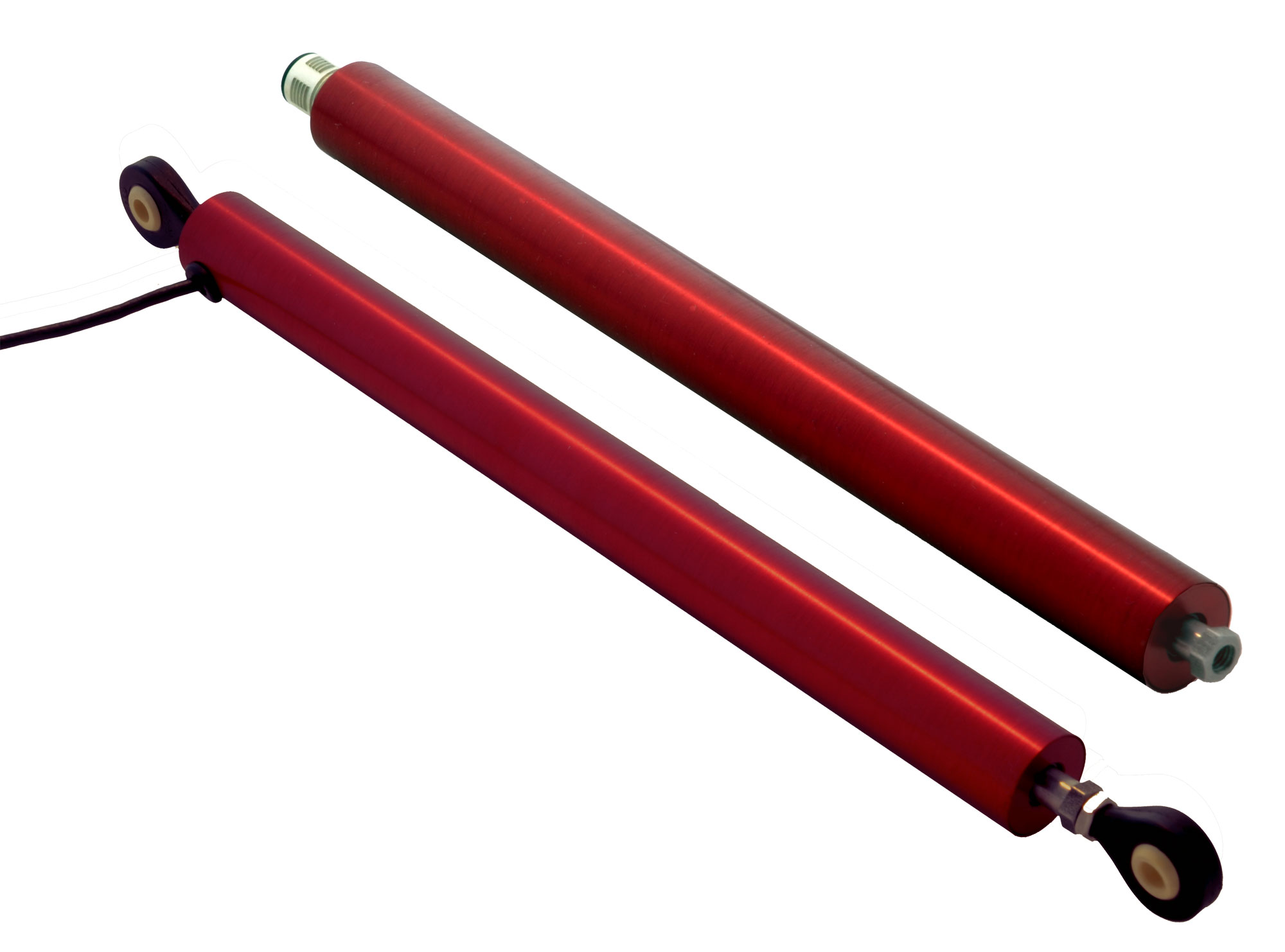
The LR-19 series LVIT (Linear Variable Inductance Transducer) position sensors by Alliance Sensors Group are contactless devices designed for factory automation and a variety of industrial and commercial applications, such as: motorsport vehicles, automotive testing, solar cell positioners, wind turbine prop pitch and brake position, and packaging equipment. A compact design with superior performance, and excellent stroke-to-length ratio, the LR-19 sensors are ideal for industrial testing, laboratories and OEM applications.
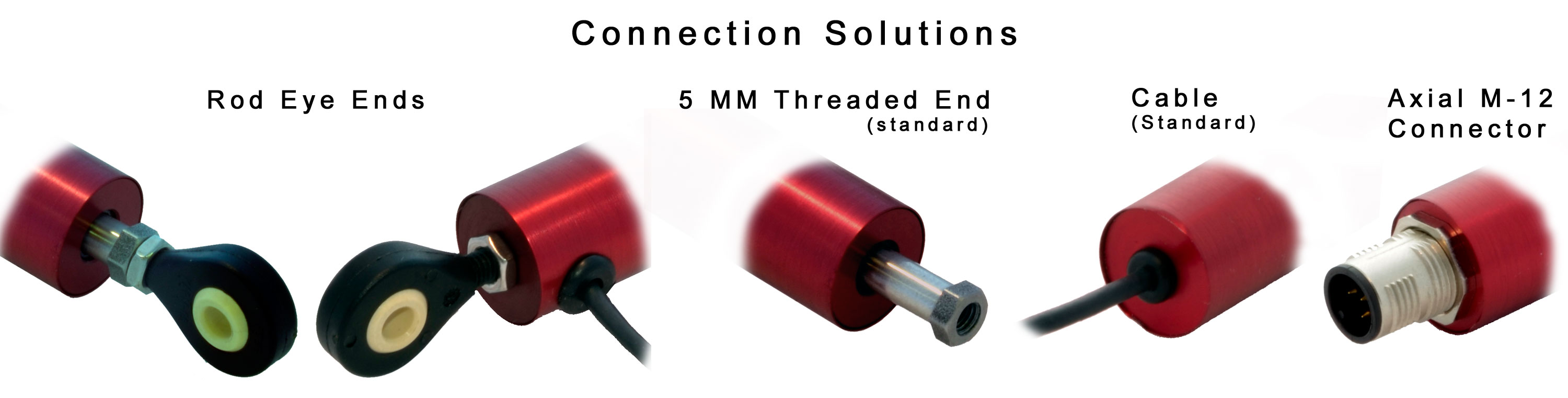
LR-19 sensors are offered in 6 full scale ranges from (1 to 8 inches) 25 to 200 mm. Operating from a variety of DC voltages, these sensors offer a choice of four analog outputs and all include ASG’s proprietary SenSet™ field recalibration feature. LR-19 products are available with axial cable or connector terminations, or with radial exiting cable or two swivel rod eye ends for easy installation.
The LR series also includes a larger body version, the LR-27 for applications which require a heavy-duty unit.
For more information see the technical datasheets below.
- - Excellent Stroke-to-Length Ratio
- - LVIT Technology™ (Linear Variable Inductance Transducer)
- - Contactless Operation Prevents Wearout from Dither or Cycling
- - Proprietary Senset™ Field Adjustable Range Scaling
- - 10-32 or M5 x 0.8 Male or Female Thread on End of Axial Operating Rod
- - Axial Termination Version with Either M-12 Connector or 1 m Cable
| Analog I/Os: | 0 - 5 V or 0.5 - 4.5 V output with 8 -30 V input, 35 mA max. 0 -10 V output with 12 - 30 V input, 35 mA max. 4 - 20 mA (3-wire) output with 18 - 30 V input, 60 mA max. (75 C max.) |
| FS Measuring Ranges: | 25 mm to 200 mm (1 to 8 inches) full scale (nominal) |
| Linearity Error: | ±0.15% of Full Scale Output (FSO) typical, ±0.25% max. |
| Resolution: | 0.025% of FSO |
| Update Rate: | 300 Hz nominal |
| Operating Temperature: | -20 C to 85 C (-40 C to 105 C Extended Temperature Range) |
| Temperature Coefficient: | ≤±0.015% of FS/deg C |
| Vibration: | 5-20 Hz 0.5 inch p-p; 20-200 Hz 4.2 g p-p |
| Shock: | 1000 g, 11 msec. |
| Terminations: | IEC IP-67 |
| Humidity: | 95% RH, non-condensing |
Electrical Termination | |||||||
|
| Housing | Range | Axial | Termination |
|
|
LR | X- | XX- | XXX- | X- | XX- | XX- | X- |
| E - Voltage | 19 - 19mm | 025 - 25 mm | A - Axial | 00 - 1 m cable | 05 - 0.5 to 4.5 VDC | A - Aluminum |
| I - Current |
| 050 - 50 mm | R - Radial (cable only) | 01 - 5-pin M12 | 06 - 4.5 to 0.5 VDC | S - Stainless Steel |
|
|
| 075 - 75 mm |
|
| 10 - 0 to 10 VDC |
|
|
|
| 100 - 100 mm |
|
| 11 - 10 to 0 VDC |
|
|
|
| 150 - 150 mm |
|
| 20 - 4 to 20 mA |
|
|
|
| 200 - 200 mm |
|
| 21 - 20 to 4 mA |
|
|
|
|
|
|
| 50 - 0 to 5 VDC |
|
|
|
|
|
|
| 51 - 5 to 0 VDC |
|
Wiring Table | ||
Function | Pin | Cable Color |
DC power input | 1 | Red |
Ground | 2 | Black |
LRE voltage output | 3 | Green |
LRI current output | 4 | Green |
SenSet™ | 5 | White |
Unit Length Table | ||
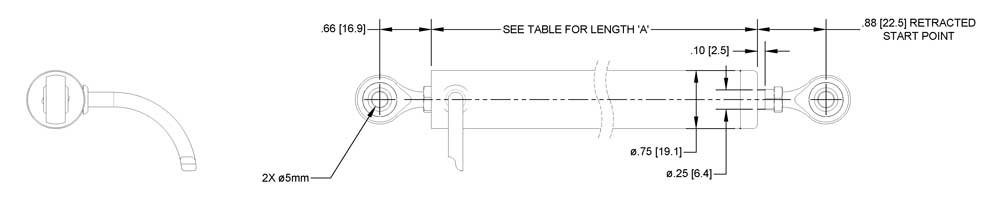
Linear Range | Length “A” | |
1.0 inch [25 mm] | 3.74 inches [95.0 mm] | |
2.0 inches [50 mm] | 4.74 inches [120.4 mm] | |
3.0 inches [75 mm] | 5.74 inches [145.8 mm] | |
4.0 inches [100 mm] | 6.74 inches [171.2 mm] | |
6.0 inches [150 mm] | 8.74 inches [222.0 mm] | |
8.0 inches [200 mm] | 10.74 inches [272.8 mm] | |
If you are looking for CAD drawings of our LR-19 sensor, simply call us at 856-727-0250 or use the online contact us form by clicking here.

 Download LR-19 LVIT Linear Position Sensor Datasheet
What Is the LR-19 and What Is It Designed For?
The LR-19 is the standard automation-duty LVIT in the Alliance Sensors Group product line, housed in a 0.750-inch (19 mm) OD stainless steel body optimized for the continuous cycling duty and moderate environmental exposure typical of factory automation and fluid power applications. As a DC-in/DC-out sensor, the LR-19 provides conditioned analog output directly from the sensor without external signal conditioning, simplifying integration with PLCs and reducing the component count in automated machine designs.
Available in six full-scale ranges from 25 mm to 200 mm (1 to 8 inches), with axial or radial cable exit options, M12 connector or direct cable termination, and aluminum or stainless steel housings, the LR-19 is configured to fit a wide range of automation, testing, and OEM integration requirements.
How Does LVIT Technology Compare to Other Linear Position Sensors?
Price-Performance Advantage Over LVDTs, Potentiometers, and Magnetostrictive Sensors
LVIT technology offers an excellent price-to-performance ratio compared to other linear position sensing technologies. An AC-LVDT provides comparable contactless measurement accuracy but requires an external signal conditioner — adding cost, wiring complexity, and an additional point of failure. Linear potentiometers are inexpensive but wear out due to physical contact between the wiper and resistive element, introducing noise, signal degradation, and recurring replacement costs. Magnetostrictive sensors deliver long-range measurement but at significantly higher price points and with greater sensitivity to mechanical shock.
The LR-19 occupies the practical middle ground: contactless inductive sensing that eliminates the wear issues of potentiometers, DC-in/DC-out operation that eliminates the signal conditioner required by AC-LVDTs, and a price point well below magnetostrictive alternatives. For automation engineers evaluating position sensor options, the LR-19 provides the measurement quality of a contactless sensor with the wiring simplicity and cost structure that production equipment budgets require.
Best-in-Class Stroke-to-Length Ratio
The LR-19’s LVIT sensing principle — inductive coupling between a coil and a moving spoiler — produces a favorable stroke-to-body-length ratio compared to an equivalent AC-LVDT. The LVIT needs only slightly more body length than its measurement range, while an LVDT requires additional length for the null region at the primary coil and the secondary coil pair. For installations where the available mounting depth is constrained, this ratio advantage can be the deciding factor between using an LVIT and an LVDT for the same measurement range.
This compact body length is particularly valuable in retrofits where the LR-19 replaces a potentiometer or other sensor in an existing machine. Because the overall sensor length only increases by a small percentage beyond the stroke, the LR-19 fits into mounting envelopes that would not accommodate a longer AC-LVDT of equivalent range.
Key Applications for the LR-19
Factory Automation and Packaging Equipment
The LR-19 is a natural fit for automated machinery where position feedback drives repetitive motion control — packaging equipment, labeling machines, fill-level verification, conveyor positioning, and pick-and-place systems. The contactless sensing principle means the sensor does not wear out from the continuous cycling and dithering that destroy potentiometers in these applications, and the DC output connects directly to the PLC without additional electronics.
Automotive Testing and Motorsports
In automotive R&D and motorsport environments, the LR-19 provides fast, accurate position data for suspension travel measurement, throttle and brake actuator testing, pedal position feedback, and component durability testing. The 1,000 g shock rating and IP67 environmental sealing handle the vibration and fluid exposure common in vehicle test environments.
Renewable Energy Systems
Solar tracking systems and wind turbine pitch and brake controls use the LR-19 for actuator position feedback in outdoor installations. The extended temperature range option (-40°C to 105°C) covers the full range of ambient conditions these systems encounter, and the contactless design eliminates maintenance visits for sensor replacement in remote or difficult-to-access installations.
OEM and Test Laboratory Applications
For OEM equipment builders and test labs, the LR-19’s combination of SenSet™ field programmability, multiple output options, and flexible termination configurations simplifies integration across product lines and test fixtures. A single LR-19 model can be stocked and field-adjusted to different stroke ranges, reducing inventory complexity for manufacturers who build machines with varying position measurement requirements.
LR-19 vs. LR-27: When Does the Larger Sensor Make Sense?
The LR-27 shares the same core contactless LVIT design and operating rod architecture as the LR-19 but features a more robust 27 mm outside diameter (OD) housing. The larger body and thicker structural walls accommodate heavy-duty mechanics, providing greater resistance to physical deflection, high-vibration stresses, and structural impacts in punishing operational environments. If your application involves high physical shock hazards, severe mechanical cycling, or requires a heavy-duty frame to withstand harsh industrial wear, the LR-27 provides a distinct mechanical advantage. For standard automation duty with restricted installation space and moderate physical stress, the LR-19 delivers the exact same measurement accuracy in a more compact, lightweight, and cost-effective package.
Electrical Output and Field Calibration
DC-In/DC-Out with No External Signal Conditioner
The LR-19 operates from 8–30 VDC input and provides conditioned analog output without any external signal conditioning module. Available outputs include 0–5 V, 0.5–4.5 V, 0–10 V, and 4–20 mA, with reverse-acting versions of each. This DC-in/DC-out architecture is one of the key practical advantages of LVIT technology over AC-LVDTs, which require an external signal conditioner to convert the AC sensor output to a DC signal usable by the control system.
SenSet™ Field Programmability
All LR-19 sensors include ASG’s SenSet™ feature for zero and full-scale output adjustment at the point of installation. This allows the sensor’s output to be matched precisely to the actual mechanical range of motion without factory recalibration — particularly useful in OEM applications where the same sensor model serves fixtures with slightly different travel distances.
Key Specifications
Housing Diameter: 27 mm (1.06 inches) OD
Mechanical Construction: Heavy-duty, thick-walled design for superior structural rigidity and resistance to high-vibration and physical impact.
Standard Measuring Ranges: 25 mm to 150 mm (1 to 6 inches)
Housing Material: Anodized aluminum (standard) or 300-series stainless steel (optional for harsh/corrosive environments).
Operating Rod/Target: Rugged axial operating rod with #10-32 or M5 x 0.8 male or female threads.
Environmental Protection: Sealed to IEC IP-67 standards.
Shock & Vibration Resistance: * Shock Rating: 1000g for 11 ms Vibration Rating: 4.2g peak-to-peak
Ideal Mechanical Applications: Heavy industrial environments, high physical shock hazards, severe mechanical cycling, and applications with potential for side-loading or structural stress.
- > Note: For extended mechanical travel up to 450 mm (18 inches), refer to the companion LRL-27 series.