




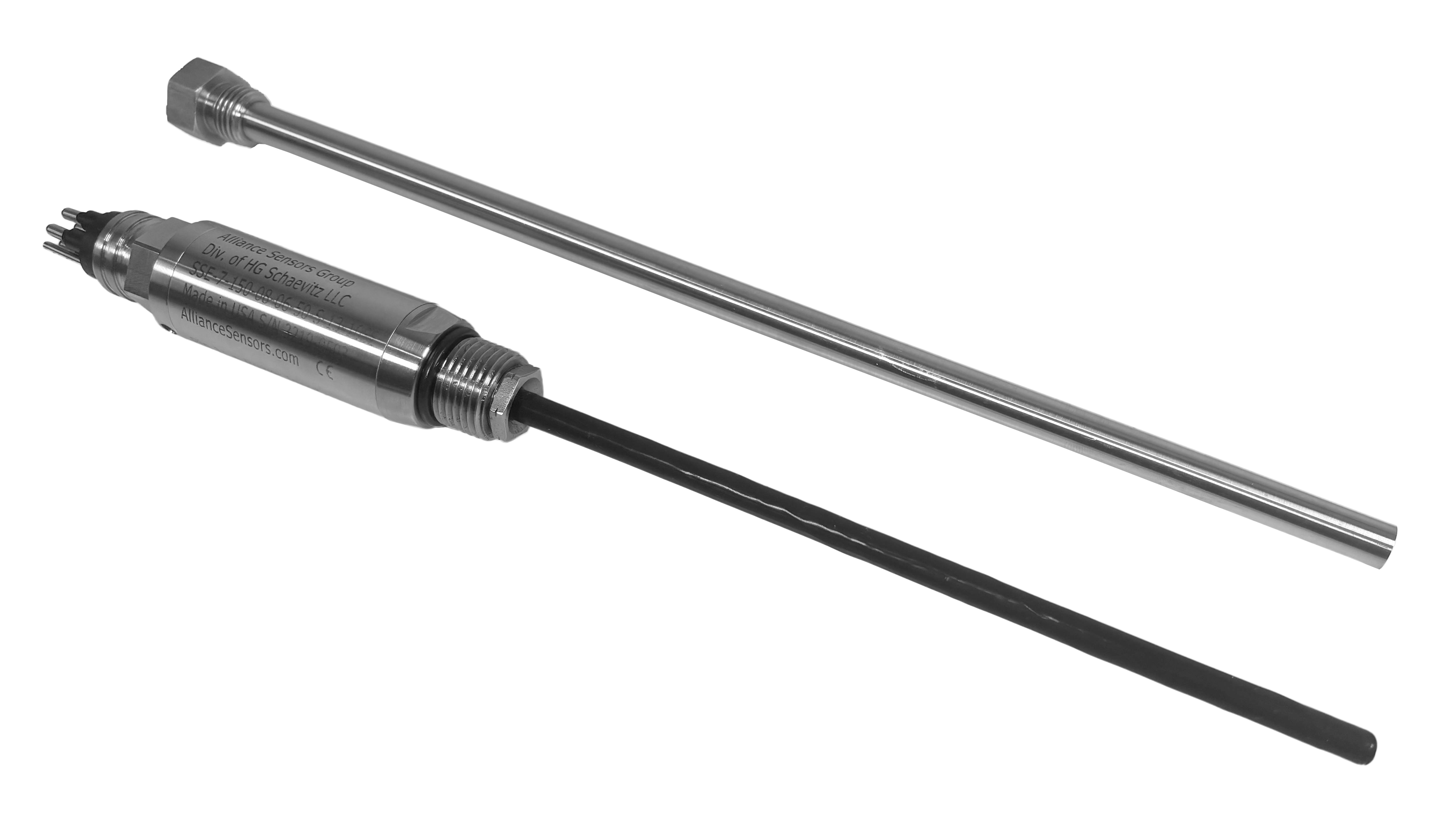
The SS-7 series LVIT (Linear Variable Inductance Transducer) position sensors from Alliance Sensors Group have been designed to give cylinder position feedback in subsea environments with depths up to 12,000 ft or in a PBOF (pressure balanced oil filled) chamber; for oil and gas exploration, blow out preventers, ROVs, and relief valves.
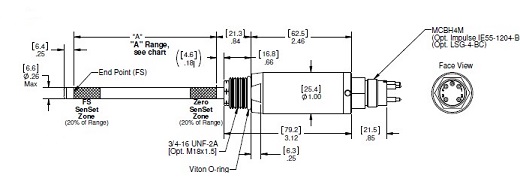
The SS-7 requires no magnet and is based on a proprietary, contactless, inductive, sensing technology that employs a 7 mm diameter probe inserted into a target taube mounted inside of a gun drilled hole in the cylinder. The 1-inch diameter, 316 stainless steel housing comes with a subsea connector. They are offered in ranges from 1 to 36 inches (25 to 900 mm) full scale with a wide variety of analog I/Os and superior stroke-to-length ratio. The SS-7 sensors are also offered with ASG’s proprietary SenSet™ feature whereby a sensor’s analog output can be easily adjusted in the field after installation to match the range of motion of the cylinder rod.
Technical datasheets and additional information can be found below.
- - LVIT Technology™ (Linear Variable Inductance Transducer)
- - Operational to 12,000 ft depth or 5000 psig (350 bar)
- - Contactless...No Wear from Cycling or Dithering
- - Proprietary SenSet™ for Field Adjustable Range Scaling
| Analog I/Os: | 0 – 5 V or 0.5 – 4.5 V output with 8 – 30 V input, 35 mA max. 0 – 10 V output with 12 – 30 V input, 35 mA max. 4 – 20 mA (3-wire) output with 18 – 30 V input, 60 mA max. (75 C max.) |
| Measuring Ranges: | 25 mm to 900 mm (1 to 36 inches) Full Scale (nominal) |
| Linearity Error: | ±0.15% of Full Scale Output (FSO) typical, ± 0.25% of FSO max. |
| Resolution: | 0.025% of FSO |
| Update Rate: | 300 Hz nominal |
| Operating Temperature: | -20 to 85 C (-40 C to 105 C Extended Range) |
| Temperature Coefficient: | ≤±0.015% of FS/deg C |
| Operating Pressure: | 5000 psig max. (350 bar) |
| Vibration: | 5-20 Hz 0.5 inch p-p; 20-2000 Hz 4.2 g p-p |
| Shock: | 1000 g, 11 msec. |
| Output | Probe | Range | Body Diameter |
|
| Housing |
SS | X- | X- | XXX- | XX- | XX- | XX- | X |
| E -Voltage | 7 -7 | 025 - 250 (25 mm increments)
| 08 - 3/4-16 UNF | 06 - Macartney MCBH4M | 03 - 0 to 3 V DC | S - 316 SS |
| I - Current |
| 250-500 (50 mm increments) | 18 - M18 x 1.5 |
| 04 - 3 to 0 V DC |
|
|
|
| 500 - 900 (100 mm increment) |
|
| 05 - 0.5 to 4.5 V DC |
|
|
|
|
|
|
| 06 - 4.5 to 0.5 V DC |
|
|
|
|
|
|
| 10 - 0 to 10.0 V DC |
|
|
|
|
|
|
| 11 - 10.0 to 0 V DC |
|
|
|
|
|
|
| 20 - 4 to 20 mA DC |
|
|
|
|
|
|
| 21 - 20 to 4 mA DC |
|
|
|
|
|
|
| 50 - 0 to 5 V DC |
|
|
|
|
|
|
| 51 - 5 to 0 V DC |
|
4-Pin Connector | |
I/O Function | Pin |
+ Power Input | 1 |
Ground | 2 |
Analog Output | 3 |
SenSet™ | 4 |
Nominal Range | Dim. “A” In. [mm] |
25 mm | 1.0 [25.4] |
50 mm | 2.0 [50.8] |
75 mm | 3.0 [76.2] |
100 mm | 4.0 [101.6] |
125 mm | 5.0 [127.0] |
150 mm | 6.0 [152.4] |
175 mm | 7.0 [177.8] |
200 mm | 8.0 [203.2] |
225 mm | 9.0 [228.6] |
250 mm | 10.0 [254.0] |
300 mm | 12.0 [304.8] |
350 mm | 14.0 [355.6] |
400 mm | 16.0 [406.4] |
450 mm | 18.0 [457.2] |
500 mm | 20.0 [508.0] |
600 mm | 24.0 [609.6] |
700 mm | 28.0 [711.2] |
750 mm | 30.0 [762.0] |
800 mm | 32.0 [812.8] |
900 mm | 36.0 [914.4] |
If you are looking for CAD drawings of our SS-7 sensor, simply call us at 856-727-0250 or use the online contact us form by clicking here.
 Download SS-7 Series Linear Position Sensor Datasheet
What Is the SS-7 and What Makes It Subsea-Rated?
The SS-7 Series LVIT (Linear Variable Inductance Transducer) from Alliance Sensors Group is a subsea-rated in-cylinder position sensor designed for hydraulic cylinder feedback at depths up to 12,000 feet or in pressure balanced oil filled (PBOF) chambers. Built entirely in 316 stainless steel with a subsea-grade Macartney connector, the SS-7 provides the same contactless inductive sensing technology used across ASG’s in-cylinder LVIT family — adapted for the extreme pressure, corrosion, and reliability demands of offshore oil and gas operations.
The sensor employs a 7 mm diameter inductive probe housed in a compact 1-inch (25.4 mm) diameter sensor head. It mounts via 3/4-16 UNF or M18 x 1.5 male O-ring port threads, fitting standard port bosses on subsea hydraulic cylinders and actuators. Measuring ranges span 25 mm to 900 mm (1 to 36 inches), covering the full stroke spectrum of subsea valve actuators, BOP cylinders, and ROV hydraulic systems.
Why Choose LVIT Technology for Subsea Cylinder Position Sensing?
No Magnet Ring Required — Simpler Subsea Cylinder Design
Magnetostrictive sensors — the traditional choice for in-cylinder position feedback — require a permanent magnet ring assembled to the piston inside the cylinder. In subsea service, this magnet ring must survive extreme hydrostatic pressure, resist corrosion from seawater-contaminated hydraulic fluid, and maintain its magnetic properties over years of unserviced operation at depth. The SS-7 eliminates this requirement entirely. Position sensing is accomplished through a target tube mounted in a gun-drilled blind hole in the cylinder rod, with no magnets, no waveguides, and no delicate internal components that could fail at depth.
For subsea equipment manufacturers, removing the piston-mounted magnet simplifies cylinder assembly, reduces the bill of materials, and eliminates a failure mode that cannot be repaired without recovering the equipment to surface — an operation that can cost hundreds of thousands of dollars in vessel time alone.
Robust Inductive Coil vs. Magnetostrictive Waveguide
Magnetostrictive sensors use a precision waveguide and time-of-flight measurement principle that is inherently sensitive to mechanical shock. In subsea hydraulic systems — where blow-out preventer rams slam closed under emergency conditions and ROV manipulators experience repeated impact loading — waveguide-based sensors are vulnerable to damage that is invisible from outside the cylinder. The SS-7’s inductive coil sensing approach has no waveguide to fracture or deform. The simple, robust coil construction withstands 1,000 g shock and continuous vibration across the 5–2,000 Hz range, providing a mechanically tougher sensing element for equipment that must operate reliably without maintenance intervention for years at a time.
Subsea Applications for the SS-7
Blow-Out Preventer (BOP) Cylinder Position Feedback
BOPs are the last line of defense against uncontrolled well events, and reliable ram position feedback is critical to confirming that the preventer has fully closed. The SS-7 provides continuous analog position output from inside the BOP’s hydraulic cylinders, giving the control system unambiguous confirmation of ram position without relying on pressure inference or proximity switches. The 316 stainless steel construction and subsea connector survive the pressure, temperature, and corrosion conditions on the ocean floor, and the contactless sensing principle is unaffected by the hydraulic medium inside the cylinder.
ROV Hydraulic Systems and Manipulator Arms
Remotely operated vehicles depend on precise hydraulic actuator control for manipulator operations, tooling deployment, and propulsion. The SS-7’s compact 1-inch diameter head and superior stroke-to-length ratio minimize the space consumed inside ROV hydraulic cylinders, while the robust coil construction survives the repeated mechanical shock that ROV operations generate. For ROV manufacturers and operators, the SS-7 provides position feedback that remains accurate and reliable across multi-year deployment cycles without maintenance.
Subsea Valve Actuators and Christmas Tree Controls
Subsea production equipment uses hydraulic actuators to control valves on Christmas trees, manifolds, and flow control assemblies. The SS-7 provides position feedback for these actuators, enabling the topside control system to verify valve position and detect incomplete strokes that could indicate mechanical problems. The sensor’s SenSet™ programmability allows the analog output to be scaled to each actuator’s specific stroke during surface testing before deployment, eliminating the need for exact stroke-to-sensor-range matching at time of order.
PBOF (Pressure Balanced Oil Filled) Installations
For equipment operating in PBOF chambers — where the sensor is submerged in compensating oil at ambient seawater pressure — the SS-7’s 316 stainless steel construction and sealed probe provide the material compatibility and pressure resistance required. The inductive sensing principle is unaffected by immersion in hydraulic or compensating oil, and the absence of internal air gaps or compressible elements means the sensor’s calibration is not affected by the hydrostatic pressure at depth.
SS-7 vs. MR-7: When Do You Need the Subsea Version?
The SS-7 and MR-7 share the same 7 mm LVIT probe technology, the same measurement ranges, and the same contactless sensing principle. The differences are in the materials and connections designed for the operating environment:
SS-7: 316 stainless steel housing, Macartney subsea connector, rated to 12,000 ft depth
MR-7: Aluminum or stainless steel housing, standard industrial connector, rated to 5,000 psig
For industrial and mobile hydraulic applications at atmospheric pressure or in factory environments, the MR-7 provides the same measurement performance at lower cost. For any application where the sensor will be submerged, exposed to seawater, or installed in a PBOF environment, the SS-7’s 316 SS construction and subsea connector are required. If you are unsure which version your application needs, ASG’s application engineers can help determine the right specification based on your operating depth, pressure, and fluid exposure conditions.
Electrical Output and Field Calibration
Analog Output Options
The SS-7 provides DC-in/DC-out operation with multiple analog outputs: 0–3 V, 0–5 V, 0.5–4.5 V, or 0–10 V voltage outputs, and 4–20 mA current output. Reverse-acting outputs are available for all voltage and current options. All outputs connect directly to subsea control modules or topside PLCs through the Macartney 4-pin subsea connector without external signal conditioning.
SenSet™ Field Programmability
The SS-7 includes ASG’s SenSet™ feature, allowing the analog output to be scaled to the actual cylinder stroke during surface testing and commissioning. This is particularly valuable in subsea applications where the sensor cannot be accessed after deployment. Setting the output endpoints during factory acceptance testing ensures the control system receives a properly scaled signal from day one of subsea operation, eliminating the need for post-deployment calibration that would require equipment recovery.
Key Specifications
Measuring ranges: 25 mm to 900 mm (1 to 36 inches) full scale
Linearity error: ±0.15% FSO typical, ±0.25% FSO maximum
Resolution: 0.025% of full scale output
Update rate: 300 Hz nominal
Operating depth: 12,000 feet (3,650 meters) or PBOF
Operating pressure: 5,000 psig (350 bar)
Shock: 1,000 g, 11 msec
Vibration: 5–20 Hz at 0.5 inch p-p; 20–2,000 Hz at 4.2 g p-p
Housing material: 316 stainless steel
Connector: Macartney MCBH4M subsea connector
Port threads: 3/4-16 UNF or M18 x 1.5 male O-ring
Operating temperature: -20°C to 85°C (-40°C to 105°C extended range)
Temperature coefficient: ≤0.015% FS/°C