




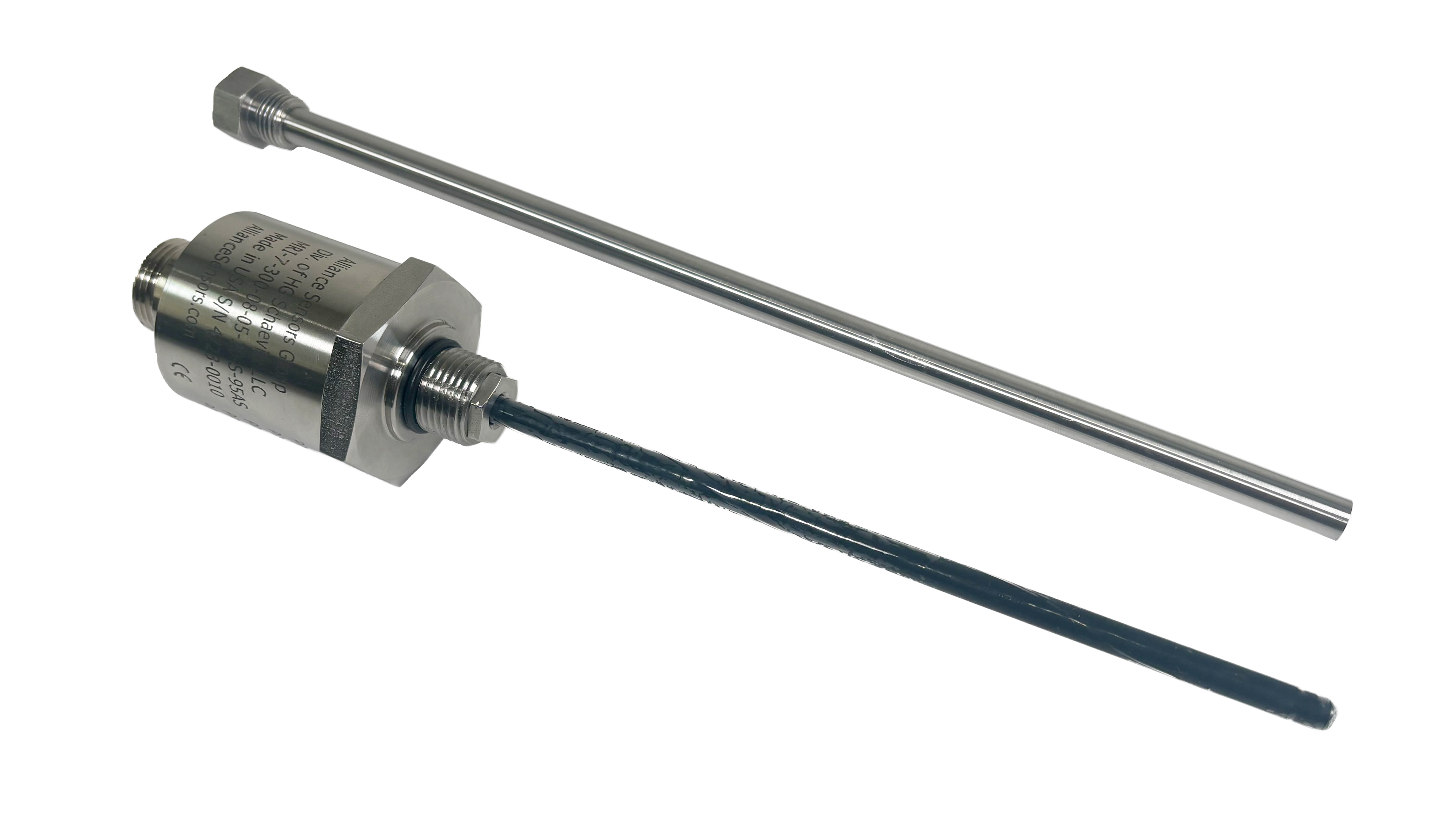
The MR-7 Series LVIT (Linear Variable Inductance Transducer) Position Sensors from Alliance Sensors Group has been designed as an alternative to magnetostrictive sensors and has more robust construction and a lower cost of ownership. The unit can be port mounted in industrial or mobile hydraulic cylinders and pneumatic actuators. These MR-7 Series sensors are based on a proprietary contactless inductive sensing technology that employs a 7 mm diameter probe inserted into a target tube mounted inside of a gun-drilled blind hole in the cylinder rod.
An MR-7 has a 1.75 inch (44.5 mm) hex sensor head with a male o-ring port thread, so it can be mounted in the same SAE dash 8 or 18 mm o-ring port as magnetostrictive sensors. Because they are contactless, MR-7 Series sensors do not wear out and have no signal deterioration over the life of the sensors, and because it uses an inductive coil, an MR-7 sensor can withstand much greater shock and vibrations than other technologies. One very useful element of the MR-7 sensors is ASG’s proprietary SenSet™ feature whereby a sensor’s analog output can be easily adjusted in the field after installation to match the range of motion of the cylinder rod.
Technical datasheets and additional information can be found below.
- - LVIT Technology™ (Linear Variable Inductance Transducer)
- - Easily Adapts to Existing Cylinder Designs
- - Contactless Sensing for Long Sensor Life
- - Proprietary SenSet™ for Field Scalability of Analog Output
| Analog I/Os: | 0 – 5 V or 0.5 – 4.5 V output with 8 – 30 V input, 35 mA max. 0 – 10 V output with 12 – 30 V input, 35 mA max. 4 – 20 mA (3-wire) output with 18 – 30 V input, 60 mA max. (75 C max.) |
| Measuring Ranges: | 0-25 mm to 0-900 mm (1 to 36 inches) Full Scale (nominal) |
| Linearity Error: | ±0.15% of Full Scale Output (FSO) typical, ±0.25% of FSO max. |
| Resolution: | 0.025% of FSO |
| Update Rate: | 300 Hz nominal |
| Operating Temperature: | -20 to 85 C (-40 C to 105 C Extended Range) |
| Temperature Coefficient: | ≤±0.015% of FS/deg C |
| Operating Pressure: | 5000 psig (350 bar) max operating, 7500 psig (520 bar) proof |
| Vibration: | 5-20 Hz 0.5 inch p-p; 20-2000 Hz 4.2 g p-p |
| Shock: | 1000 g, 11 msec |
| Terminations: | IEC IP-67 |
| Humidity : | 95% RH, non-condensing |
| Output | Probe | Range | Port |
|
| Housing |
MR | X- | X- | XXX- | XX- | XX- | XX- | X |
| E -Voltage | 7 -7 mm | 025 - 250 (25 mm increments)
| 08 - 3/4-16 | 00 - 1-m cable | 05 - 0.5-4.5 V | A - Aluminum |
| I - Current |
| 250-500 (50 mm increments) | 18 - M18 | 01 - 5-pin M12 | 06 - 4.5 to 0.5 V | S - 300 Series SS |
|
|
| 500 - 900 (100 mm increment) |
| 10 - 0 to 10.0 V |
| |
|
|
|
|
|
| 11 - 10.0 to 0 V |
|
|
|
|
|
|
| 20 - 4 to 20 mA |
|
|
|
|
|
|
| 21 - 20 to 4 mA |
|
|
|
|
|
|
| 50 - 0 to 5 V |
|
|
|
|
|
|
| 51 - 5 to 0 V |
|
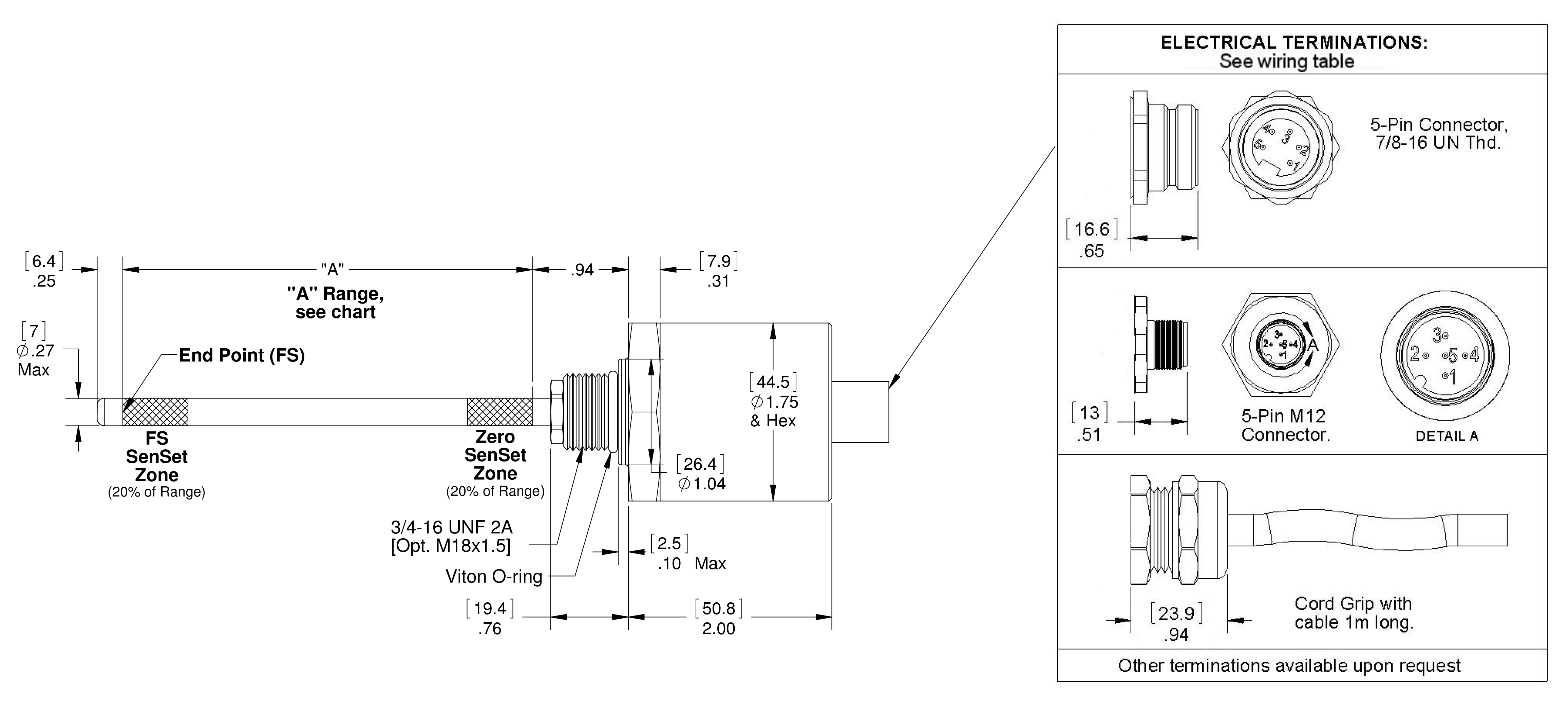
 Download LVIT Linear Position Sensor MR-7 Datasheet
What Is the MR-7 and How Does It Mount?
The MR-7 Series LVIT (Linear Variable Inductance Transducer) from Alliance Sensors Group is a port-mounted in-cylinder position sensor designed as a direct drop-in replacement for magnetostrictive sensors in industrial, mobile, and subsea hydraulic cylinders and pneumatic actuators. The sensor features a 1.75 inch (44.5 mm) hex sensor head with male O-ring port threads that fit standard SAE J1926-8 or ISO 6149-1 M18 port bosses — the same ports used by magnetostrictive sensors — allowing the MR-7 to replace existing magnetostrictive installations without modifying the cylinder.
The MR-7 employs a 7 mm diameter inductive probe that inserts into a target tube mounted inside a gun-drilled blind hole in the cylinder rod. This contactless sensing approach requires no permanent magnet ring, and in applications where the MR-7 replaces an existing magnetostrictive sensor, the magnet ring can usually be left in place without affecting performance. Measuring ranges span 25 mm to 900 mm (1 to 36 inches), covering the full range of industrial and mobile hydraulic cylinder strokes.
Why Replace a Magnetostrictive Sensor with the MR-7?
More Robust Construction at Lower Cost of Ownership
Magnetostrictive sensors rely on a precision waveguide and time-of-flight measurement principle that, while accurate, makes the sensing element vulnerable to mechanical shock and vibration. The MR-7’s inductive coil sensing approach has no waveguide to damage — it uses a simple, robust coil design that withstands the intense shock loads and sustained vibration common in mobile hydraulic equipment, industrial presses, and heavy machinery. For cylinder manufacturers and end users who have experienced magnetostrictive sensor failures in high-shock environments, the MR-7 provides a mechanically tougher alternative that fits the same port location.
No Magnet Ring Required
Magnetostrictive sensors require a permanent magnet ring assembled to the piston inside the cylinder. This ring must be properly oriented, securely attached, and protected during cylinder assembly. The MR-7 eliminates this requirement entirely — position sensing is accomplished through the target tube and gun-drilled rod alone. This simplifies cylinder manufacturing, removes a potential failure point inside the pressurized cylinder bore, and reduces the bill of materials for each cylinder build.
MR-7 vs. ME-7: Port-Mounted vs. Embedded Installation
Both the MR-7 and ME-7 use the same 7 mm LVIT probe technology and cover the same measurement ranges. The difference is the mounting method: the MR-7 threads into an O-ring port boss from outside the cylinder, while the ME-7 embeds into a cavity in the cylinder end cap with O-ring sealing and set screw retention. The MR-7’s port-mount design allows the sensor to be installed and removed without disassembling the cylinder — making it the preferred choice for retrofit applications and installations where field serviceability is important.
Key Applications for the MR-7
Industrial Hydraulic Cylinder Position Feedback
In industrial hydraulic systems — presses, injection molding machines, metal forming equipment, and factory automation cylinders — the MR-7 provides closed-loop position feedback with the mechanical robustness to survive continuous operation in high-vibration, high-cycle environments. The port-mount installation keeps the sensor accessible for inspection or replacement during scheduled maintenance windows.
Mobile Hydraulic Equipment
Construction, agriculture, forestry, and material handling equipment all depend on hydraulic cylinders operating in mechanically punishing conditions. The MR-7’s shock and vibration resistance exceeds what magnetostrictive sensors can tolerate, and the absence of an internal magnet ring eliminates a common failure mode in mobile equipment where piston impacts can dislodge or demagnetize the targeting magnet.
Subsea and Marine Hydraulic Systems
The MR-7 can be submerged for subsea hydraulic applications, providing cylinder position feedback for blow-out preventers, ROVs, relief valves, and Christmas tree actuators in oil and gas exploration. The contactless inductive sensing principle is unaffected by the hydraulic medium, and the robust coil construction survives the pressure and temperature conditions of deep-water service.
Electrical Output and Field Calibration
Analog Output Options for Direct System Connection
The MR-7 provides DC-in/DC-out operation with multiple analog output configurations: voltage outputs (0–5 V, 0.5–4.5 V, 0–10 V) and 4–20 mA current output. Reverse-acting outputs are available for applications requiring inverted feedback. All outputs connect directly to PLCs, motion controllers, and hydraulic control systems without external signal conditioning.
SenSet™ Field Programmability
The MR-7 includes ASG’s SenSet™ feature, allowing the analog output to be scaled after installation to match the actual stroke of the cylinder rod. This is particularly valuable in retrofit applications where the replacement sensor’s nominal range may not exactly match the previous magnetostrictive sensor’s calibrated range — SenSet allows the output to be adjusted on-site to match the cylinder’s mechanical endpoints without returning the sensor for factory recalibration.
Key Specifications
Measuring ranges: 25 mm to 900 mm (1 to 36 inches) full scale
Linearity error: ±0.1% of full scale output
Frequency response: 300 Hz (-3 dB)
Operating pressure: 5,000 psig (350 bar)
Sensor head: 1.75 inch (44.5 mm) hex with male O-ring port thread
Port compatibility: SAE J1926-8 and ISO 6149-1 M18 O-ring boss
Housing material: aluminum or stainless steel
Operating temperature: -40°C to 105°C (extended range)
Contactless inductive sensing — no magnet ring required
SenSet™ field-adjustable analog output